


Test–Teach–Test (TTT) in ELT: A Practical Guide for CELTA, TEFL and DELTA Teachers
Learn the Test–Teach–Test framework with a 45-minute CELTA lesson plan, diagnostic teaching examples, skills applications and practical tips.
Find the gap. Bridge the gap. Then check that the bridge holds.
Imagine spending half an hour preparing a beautiful grammar presentation. You've got your marker sentences, timelines, concept-checking questions (CCQs), pronunciation work and practice activities ready.
You walk into class, explain everything carefully, and only then discover that most of your learners already knew the language.
What a waste of teaching time!
Now imagine doing something different.
Instead of explaining first, you give learners a short task. You watch how they perform. Some answer confidently. Others hesitate. A few make mistakes that tell you exactly what they haven't understood.
Suddenly, you know what needs your attention.
You haven't started teaching the language yet, but you've already made one of the most important teaching decisions: what is actually worth teaching.
Welcome to Test–Teach–Test (TTT).
This is one of my favourite frameworks to explore with teachers on CELTA and TEFL courses, particularly because it challenges a habit many of us develop: planning what we're going to say before finding out what our learners need.
And here's the interesting part: TTT is much more than three stages on a lesson plan.
It's a way of thinking.
What is the Test–Teach–Test framework?
Test–Teach–Test is a lesson framework in which learners first attempt a task, the teacher uses their performance to identify learning needs, and then learners complete another task after focused teaching.
The three main stages are:
- Test 1 — DiagnoseFind out what learners already know, what they partly understand and what they struggle with.
- Teach — RespondAddress the difficulties revealed by Test 1. Clarify what learners need rather than automatically teaching everything you prepared.
- Test 2 — Check progressGive learners another opportunity to use the language or skill and see what has improved and what still needs attention.
Don't be put off by the word test.
In a typical TTT lesson, we're not talking about a formal examination, marks or grades. We're talking about a diagnostic task that provides information to guide the teaching.
In fact, Task–Teach–Task is another useful way of thinking about the same sequence.
The real purpose of TTT: bridging the gap
Think of learners standing on one side of a bridge.
On one side is what they can already do. On the other is what they need to be able to do.
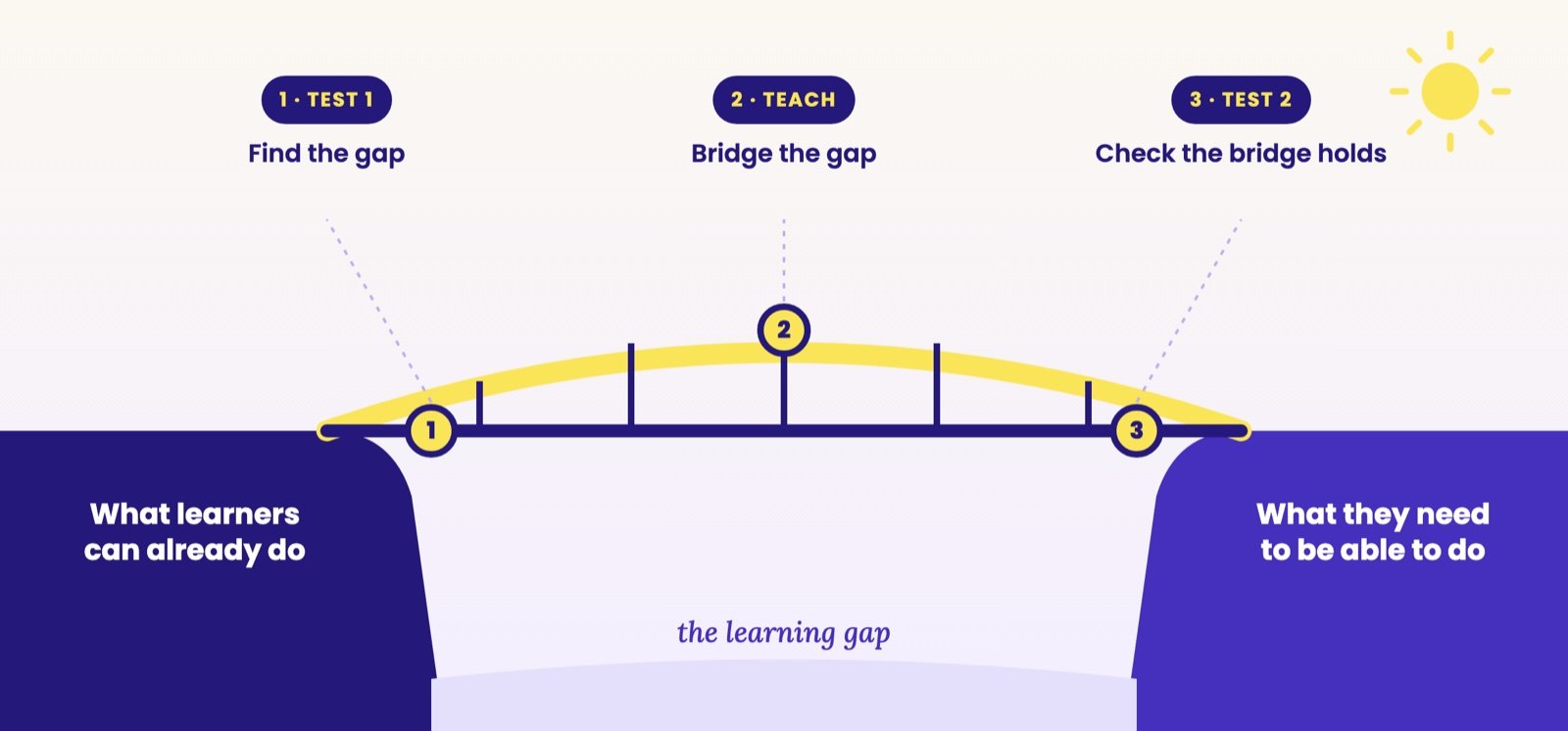
To bridge the gap, we first have to find out where it is. This is the core behind the framework.
Test 1 tells us where learners are.
The Teach stage helps them move forward.
Test 2 allows us to see whether that support has made a difference.
The key principle is simple:
If your Teach stage does not respond to learners' performance, needs and difficulties revealed by Test 1, you are not genuinely following the logic of TTT. You're delivering a pre-planned lesson with a test at the beginning.
And that's exactly where many teachers go wrong.
Test 1: Don't teach yet. Diagnose.
Let's say you're teaching an intermediate class, and your lesson focuses on phrasal verbs related to work.
You've prepared language such as clock in, clock out, call in sick, knuckle down, slack off and lay off.
A conventional approach might be to start explaining each expression.
But why assume that all six are unfamiliar?
Perhaps learners already use call in sick naturally. Perhaps they understand slack off but cannot pronounce it confidently. Perhaps they confuse clock in with clock out.
You won't know until you give them a chance to show you.
So you begin with a short diagnostic task. Learners might match expressions to workplace situations or complete sentences using the appropriate phrasal verbs.
While they work, your job is not to explain.
Your job is to observe, listen and collect evidence.
Look for more than incorrect answers. Notice hesitation, guessing, avoidance and differences between learners. A correct answer doesn't always mean secure understanding.
For example, a learner might choose clock out correctly but be unable to explain whether it happens at the beginning or end of the working day.
That's useful information.
How should Test 1 work?
Start with a clear context and an achievable task. Allow learners to work individually so you can see what each person knows, then give them a short opportunity to compare answers.
During feedback, establish which answers are correct and identify problematic items without turning every question into a mini-presentation.
Most importantly, don't spoon-feed learners during the diagnostic task. If you explain the difficult language before they've attempted it, you've lost the opportunity to discover what they could do independently.
And remember to reassure them.
You might simply say:
“Do your best. It's fine if you don't know every answer. This activity helps me decide what we need to work on.”
Test 1 is not there to embarrass learners. It is there to inform your decisions.
The Teach stage: This is where the real decisions happen
Now comes the part that separates a responsive TTT lesson from a pre-planned presentation.
Imagine the results look like this:
| What you noticed in Test 1 | What you might do in the Teach stage |
|---|---|
| Almost everyone understands call in sick. | Skip a full explanation; confirm quickly if necessary. |
| Several learners confuse clock in and clock out. | Clarify the difference through context and CCQs. |
| Learners know what knuckle down means but struggle to pronounce it. | Focus on pronunciation rather than re-teaching meaning. |
| Most learners misunderstand lay off. | Clarify meaning, form and pronunciation more fully. |
| Two learners make a mistake that the rest of the class does not make. | Give brief individual support or use peer explanation. |
Notice what has happened.
Your lesson plan hasn't disappeared. You've simply used it intelligently.
Plan for everything. Teach what they need.
You should still prepare a thorough language analysis before the lesson, including meaning, form, pronunciation, anticipated problems and possible CCQs. But preparation does not mean you must deliver every explanation.
You need to be ready to teach all the items while remaining willing to teach only some of them.
And there's another important point: a weak Teach stage is not necessarily a short one. A weak Teach stage is one that fails to address the problems learners actually have.
If learners need clarification, give it properly. If they need pronunciation work, don't spend five minutes defining a word they already understand.
How do we clarify language without spoon-feeding?
One procedure I use in training is CECDW:
C — Context: Establish a situation that makes the meaning clear.
E — Elicit: Give learners an opportunity to produce or recognise the target language.
C — Concept-check: Ask focused questions to confirm understanding.
D — Drill: Model and practise pronunciation where necessary.
W — Write: Highlight the written form, including relevant spelling, grammatical or lexical patterns.
For example, imagine you're clarifying clock out.
You show someone finishing their shift and recording the time.
You ask:
“What's the employee doing?”
If learners cannot produce the expression, you supply it naturally.
Then you check the concept:
“Is the employee starting or finishing work?”
“Are they recording the time?”
You model and drill the phrase, draw attention to any problematic sounds or stress, and show its written form.
You've covered what learners need without turning the stage into a lengthy lecture.
CECDW is a useful planning sequence, not an inflexible law. Adapt the procedure to the language point, learners and particular difficulty revealed by Test 1.
Test 2: Did the bridge hold?
You've identified the gaps and responded to them. But how do you know whether your teaching helped?
You give learners another opportunity to perform.
This is Test 2.
For our workplace vocabulary lesson, learners could complete a short dialogue containing the same target phrasal verbs in new sentences. After that, they might discuss workplace experiences with a partner.
Here, I often distinguish between two useful components:
Controlled work: Learners demonstrate more accurate understanding or use of the target language with sufficient support.
Freer work: Learners use the language more independently in meaningful communication.
For instance, a controlled task might involve completing a workplace conversation with the correct phrasal verbs. The freer task could involve discussing questions such as:
“Have you ever had to call in sick?”
“When deadlines approach, do you tend to knuckle down or put things off?”
“What would you do if your company started laying people off?”
The language remains connected to the lesson's context, but learners now have something meaningful to say.
Should Test 2 be identical to Test 1?
Not necessarily, and it's an important lesson-planning decision.
If learners simply complete the identical exercise again, their better results may partly reflect remembering the answers.
A parallel task is often more informative: it targets the same language or skill, at a comparable level of challenge, but uses different examples.
However, repeating a task can also have pedagogical value, especially when the aim is fluency development. The important thing is to understand what the second attempt actually tells you.
Test 2 gives you evidence of immediate progress. It does not, by itself, prove long-term learning.
And if learners are still struggling?
Don't pretend the lesson has worked. Revisit the difficulty, adjust your support and check again when appropriate.
TTT is a responsive cycle, not a rigid sequence that must work perfectly the first time.
A 45-minute Test–Teach–Test lesson plan
Let's turn the theory into a lesson you could actually teach.
The example below is adapted from a workplace phrasal-verb lesson I planned and taught. I've simplified the procedure so the underlying decisions are easy to follow.
Lesson focus: Vocabulary, with speaking as a subsidiary aim
Level: Intermediate (approximately B1/B1+)
Context: The world of work
Main aim: By the end of the lesson, learners will be better able to understand and use selected workplace phrasal verbs appropriately.
Subsidiary aim: To provide opportunities for learners to discuss workplace situations and experiences.
The timings are suggested allocations for a 45-minute lesson, not compulsory requirements of the framework.
| Stage | Time | Aim and procedure |
|---|---|---|
| Lead-in and context-setting | 4 min | Generate interest in the world of work. Learners briefly discuss what makes a good workplace or a difficult working day. |
| Test 1 — Diagnostic | 7 min | Learners complete a short workplace phrasal-verb task individually, compare answers and receive brief feedback. The teacher monitors and records difficulties. |
| Teach — Responsive clarification | 10 min | Clarify only the priority difficulties revealed by Test 1. Focus on meaning, pronunciation and form as required. |
| Test 2 — Controlled work | 7 min | Learners complete a parallel workplace task using the target expressions in a new context, then compare and check answers. |
| Test 2 — Freer practice | 11 min | Learners discuss workplace experiences in pairs, using the language where appropriate. The teacher monitors and records examples. |
| Feedback — Content and language | 6 min | Respond to learners' ideas, highlight successful language and address selected errors. |
| Total | 45 min |
What makes this plan genuinely TTT?
It's not the table.
It's what happens between the second and third rows.
If Test 1 shows that learners already understand half the phrasal verbs, I should not insist on explaining all of them simply because my slides are ready.
That time can be spent on the problematic items, better practice or more meaningful communication.
Similarly, if learners understand the meanings but struggle with word order or pronunciation, my clarification should change accordingly.
The framework is built around learners' needs, not the teacher's slides.
One practical warning: protect Test 2 and the final feedback. A long Teach stage that leaves no time for learners to apply what you've clarified defeats much of the purpose.
Can you use TTT to teach reading, listening, speaking or writing?
Absolutely. And this is one of the most overlooked applications of the framework.
Teachers often associate Test–Teach–Test with grammar or vocabulary. Yet the same diagnostic logic can be used to develop language skills.
In a systems lesson, you may be diagnosing difficulty with meaning, pronunciation or form.
In a skills lesson, you may be diagnosing a problem with a sub-skill, strategy, genre convention or the language needed to perform a task.
The question remains the same:
What can learners already do, and what is preventing them from performing more successfully?
Example 1: TTT for reading sub-skills
I used this diagnostic thinking in my DELTA Module Two work to develop learners' reading sub-skills.
Imagine your learners need to improve their ability to read for gist.
Test 1: Give learners a short article and a limited time to select the best summary or headline.
As you monitor, you notice that several learners are attempting to understand every unfamiliar word. They spend too long on individual sentences and cannot identify the main idea.
Teach: Respond to that difficulty. Model a more purposeful approach to reading for gist. Help learners use the title, opening sentences and overall organisation of the text to form a general understanding without stopping at every unknown word.
Test 2: Give learners a different text of comparable difficulty and ask them to complete a similar gist task.
Now you can examine both their answers and their approach to reading.
Did they select the main idea more successfully? Did they rely less on word-by-word decoding? Can they explain how they approached the task?
This is much more useful than simply giving learners two reading exercises and hoping their reading improves.
A critical point for CELTA and DELTA teachers: TTT can inform the instructional cycle within a receptive-skills lesson; it doesn't mean you must abandon necessary pre-reading, while-reading or post-reading work. Use the approach when a diagnostic first attempt is appropriate for the aim and learners.
Example 2: TTT for writing genres
Let's take a different situation.
Your learners need to write a formal email requesting information.
Test 1: Ask them to write a short email to a training centre asking about course dates, fees and entry requirements.
You review what they produce.
Perhaps the grammar is reasonably accurate, but the writing lacks a suitable opening and closing. The information is poorly organised. The register is too informal for the intended reader.
Teach: Rather than delivering a general grammar lesson, work on the weaknesses you observed. Use a short model email to highlight purpose, audience, organisation and appropriate language choices.
Test 2: Give learners a comparable writing situation, or ask them to redraft with clearly identified success criteria.
Then compare their work against those criteria.
Has the organisation improved? Is the register more appropriate? Can the reader find the necessary information more easily?
This is TTT applied to genre awareness and writing development, not simply grammar correction.
The same thinking can support listening tasks, spoken interaction, functional language and other carefully selected skills-based objectives.
Same framework. Different gap.
TTT or PPP: Which is better?
Neither framework is automatically better.
PPP (Presentation–Practice–Production) begins with planned language clarification and moves towards more independent use.
TTT (Test–Teach–Test) begins with evidence of learner performance and uses it to determine the focus of teaching.
If learners have never encountered the target language and have no realistic chance of completing the initial task, a Teach-first approach may be more appropriate.
TTT can be particularly useful when learners have some previous exposure, when their knowledge is uneven, or when you need to identify specific areas for development.
But don't choose a framework simply because it looks more advanced on your lesson plan.
Choose it because its logic helps your learners achieve the lesson aim.
And if you're preparing for CELTA or DELTA, be ready to justify your decisions, not simply name the framework you've selected.
Common TTT mistakes I see in teaching practice
1. Throwing learners in at the deep end.
Test 1 is too difficult, so almost everyone fails. The teacher gains little useful diagnostic information. Make the task accessible enough to reveal differences in knowledge and performance.
2. Teaching everything anyway.
The teacher discovers that learners already know several items but still presents every slide. Prepare thoroughly, then respond selectively.
3. Teaching during Test 1 feedback.
Every answer triggers an explanation before the diagnostic picture is clear. Keep initial feedback efficient and save focused clarification for the Teach stage.
4. Making the Teach stage a lecture.
The teacher explains rules for ten minutes without checking understanding or addressing the actual difficulties. Use contextualised clarification, guided elicitation, CCQs and targeted pronunciation or form work.
5. Treating Test 2 as an optional extra.
The Teach stage overruns, and learners never get a meaningful chance to try again. Protect time for the second attempt.
6. Ignoring learners' performance in freer practice.
The teacher finishes the speaking task with “Well done, everyone!” and moves on. Give content feedback, highlight successful language, then address a small number of useful errors.
Behind all six mistakes is the same problem: the teacher follows the plan without responding sufficiently to the learners.
Why TTT is more than a lesson framework
There's a reason I keep returning to this approach in teacher training.
It encourages teachers to become better observers.
Before explaining, you ask what learners already know.
Before correcting, you listen for the actual difficulty.
Before deciding that your teaching worked, you look at what learners can now do.
This is also closely related to the principle of formative assessment: information about learning becomes useful when it helps us adjust teaching and learning activities. The wider research on formative assessment supports responsive instructional decision-making; it should not be read as proof that one particular three-stage lesson shape is always superior.
And that thinking shouldn't disappear when the lesson ends.
It belongs in lesson planning, monitoring, feedback, teacher development and reflection.
Find the gap. Bridge the gap. Then check that the bridge holds.
That's the thinking behind Test–Teach–Test.
And perhaps the best question to take into your next lesson isn't “What am I going to teach?”
It's “What do my learners need me to teach, and how will I know?”
Try it in your next lesson
Choose a language point or sub-skill your learners have encountered before.
Prepare a short task that reveals what they can already do. While they work, record the difficulties you actually see. Use those observations to decide what deserves your attention.
Then give learners another meaningful opportunity to perform.
Afterwards, ask yourself:
Did I teach the lesson I had planned, or the lesson my learners needed?
Continue learning with Lumina
This article builds on an input session used in Lumina's teacher-training programmes.
You can also explore Lumina's Practical TEFL / TESOL programme, where lesson frameworks are studied through demonstrations, planning and teaching practice, or browse the YALA ELT Community for further resources.
Quick answers about Test–Teach–Test
What does TTT stand for in ELT?
In lesson-framework discussions, TTT stands for Test–Teach–Test. In other contexts, particularly when discussing classroom interaction, TTT can mean Teacher Talking Time. The two terms describe different things.
Is TTT suitable for CELTA lessons?
Yes, when the framework supports the lesson aim and learners' existing knowledge. Tutors will be interested in how effectively Test 1 informs the Teach stage and whether learners get an appropriate opportunity to apply what they've learned.
Can TTT be used for grammar and vocabulary?
Yes. It is commonly used to diagnose and address gaps in learners' understanding or use of language systems, including grammar, vocabulary and functional language.
Can TTT be used for reading and writing?
Yes. A diagnostic task can reveal a difficulty with a reading sub-skill, writing strategy or genre feature. The teacher then provides targeted support before learners attempt a comparable task.
What is the most important stage in TTT?
All three stages matter, but the relationship between Test 1 and Teach is crucial. If the teaching does not respond to the diagnosis, the framework loses its defining purpose.
Further reading: Black, P., & Wiliam, D. (2009). Developing the theory of formative assessment. Educational Assessment, Evaluation and Accountability, 21, 5–31.
Check your understanding
6 short questions. No account needed, no score, and nothing you choose or write is saved or sent anywhere.
Show the answer (no automatic checking)
Answer: C. TTT is about responding to diagnosed needs. Preparing six items doesn't mean you have to teach all six.
By Lumina Trainers
Show the answer (no automatic checking)
Answer: D. A correct answer is useful evidence, but it may not establish secure understanding. A brief CCQ or another example can help.
By Lumina Trainers
Show the answer (no automatic checking)
Answer: 1–B, 2–A, 3–D, 4–C.
By Lumina Trainers
Show the answer (no automatic checking)
Answer: B. Parallel tasks are often more informative because they assess comparable knowledge or skills in a different example. Task repetition can still be useful, depending on the aim.
By Lumina Trainers
5 You planned a TTT lesson on workplace vocabulary, but Test 1 reveals that your learners know most of the target expressions. What would you do next, and why?
Show a suggested answer
I would briefly confirm any uncertain items, then focus the Teach stage on the expressions learners still find difficult. I might use the time saved for additional meaningful practice or feedback. My decisions should come from the diagnostic evidence, not simply from the number of slides I prepared.
Suggested answer by Lumina Trainers
6 How could you apply the TTT principle to help learners improve their reading-for-gist skills?
Show a suggested answer
I could begin with a short gist-reading task and observe learners' performance and reading approach. If the evidence suggests that learners are reading word by word and losing sight of the main idea, I could model a more effective gist-reading strategy. They could then attempt a comparable task using a different text, allowing me to examine whether their approach and performance improved.
Suggested answer by Lumina Trainers
Ahmed Bin NasserCELTA Tutor & Teacher Trainer | Lumina