


Principled Eclecticism, Part 2: Method, Postmethod and the Centring Principle
The theory behind principled eclecticism: methods, postmethod pedagogy, SLA research, focus on form and Mellow's Centring Principle. Part 2 of 2.
Part 2 of 2. You know the idea. Now the theory behind it.
New to the term? Start with Part 1: a five-minute read with a real lesson and four questions you can use tomorrow.
This part is for the teacher who wants to know where principled eclecticism comes from, what the research says, and where the debates are. It is advanced. Take it one section at a time.
Before you read on: if no method is the best method, how do you choose what to do?
You choose with principles: what research says about how learners learn, plus what you see in your own class. This article is about those principles and who argued for them.
Why did ELT stop looking for one perfect method?
ELT has never been short of methods:
| Method | Main focus |
|---|---|
| Grammar-Translation | Reading, translation and explicit knowledge of language |
| Direct Method | Spoken language; generally avoided translation |
| Audiolingual | Modelling and repetition |
| Communicative Language Teaching (CLT) | Meaningful communication and language use |
Each tradition gave us ideas worth examining. None answers every classroom question.
And CLT does not exclude grammar. Communicative teaching can include it when it serves meaningful language use (Larsen-Freeman & Anderson, 2011).
Postmethod pedagogy
Kumaravadivelu (2006) argues for a more context-sensitive view of teaching. Teachers use professional judgement instead of simply following a prescribed method. He goes beyond mixing techniques: he also asks us to think critically about local realities, teacher agency, and how theory and practice connect.
The two ideas are related, but not the same:
- Principled eclecticism
- making coherent choices
- from different approaches
- Postmethod pedagogy
- how teaching knowledge is produced
- how teaching decisions are made
What does second language acquisition research add?
A warning first: no single theory of second language acquisition (SLA) gives you a ready-made recipe for every lesson. Research can inform decisions. You still have to interpret it in your context.
Rod Ellis (2005) brings together principles of instructed language learning. They include meaning-focused communication, attention to language form, chances to interact, and building both implicit and explicit knowledge.
In short: learners need more than nonstop conversation, and more than isolated rule practice.
Michael Long (1991) separates "focus on forms" and "focus on form". What do you think the difference is?
- Focus on forms: language items are the main object of teaching, often in a preselected structural order.
- Focus on form: you draw attention to a language feature inside an activity that is mainly about meaning. A problem that comes up may prompt it, or you may plan it because you expect a need.
This does not mean grammar explanation is always bad and communicative work is always good. The question is: how does this step help learning?
A brief explanation, a guided-discovery task, a pronunciation drill or an error-correction moment can all have a place. What matters is what each one helps learners notice, practise or do.
One aim, one thread: the Centring Principle
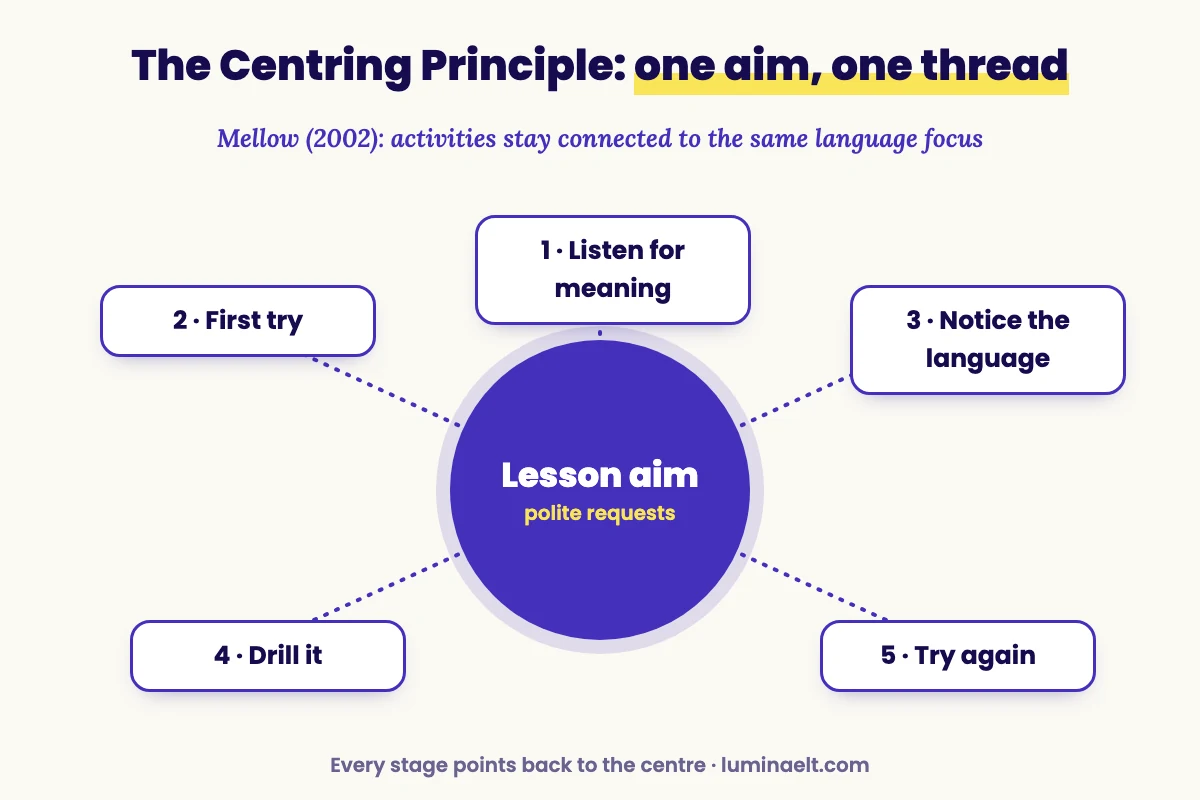
J. Dean Mellow (2002) offers a useful challenge: the Centring Principle. Put simply, the activities in a lesson should stay connected through a shared focus on relevant language forms and/or functions. The sequence should lead learners towards using language meaningfully in context.
That asks more than "use a bit of everything". If a warm-up, a grammar exercise and a speaking task have no real connection, variety alone won't make the lesson coherent.
CELTA trainees: this is a valuable planning question. DELTA candidates and experienced teachers: it opens a deeper discussion about the theory behind classroom procedures and how they link to intended learning outcomes.
Where does Harmer's ESA framework fit?
Jeremy Harmer's Engage–Study–Activate (ESA) model is one easy way to think about the balance: get learners involved, attend to language, then use it (Harmer, 2007).
| Sequence | Order |
|---|---|
| Straight Arrows | Engage → Study → Activate |
| Boomerang | A first try at communication → targeted study → further use |
These show flexible sequencing. They are not universal rules or compulsory CELTA lesson frameworks. You might use a receptive-skills framework, a task-based sequence, a text-based lesson or another structure that fits the main aim.
Context matters, including learners' first language
Your choices depend on more than the target language. Class size, level, lesson time, exams and learners' expectations all change what is possible and useful.
Your learners all share Arabic. Should you ever use it in an English lesson?
Sometimes. In some multilingual classes, working mainly in English is the most practical choice. But where learners share Arabic, a short, well-chosen comparison with Arabic can clear up a stubborn misunderstanding faster than a long explanation.
That doesn't mean translating everything. It means judging when learners' existing languages can support progress in English. Hall and Cook (2012) show why blanket rules against learners' own languages deserve a closer look.
A technique is not principled just because it is fashionable. It is not unprincipled just because it is traditional. Its value depends on the purpose, the context and what learners actually gain from it.
A final thought
A good language teacher doesn't defend one method at all costs. A good teacher doesn't just collect as many activities as possible either.
You need a broad toolkit, an understanding of the ideas behind the tools, and a sense of when to use them. Sometimes that is a carefully structured explanation. Sometimes it is a task that gets learners talking. Sometimes it is a short drill, then a chance to use that language.
Quick FAQs
What is the difference between eclecticism and principled eclecticism?
Eclecticism mixes techniques from different methods. Principled eclecticism mixes them for reasons you can state: aims, learner needs, context and evidence.
Is principled eclecticism the same as postmethod pedagogy?
No. They are related but ask different questions. Principled eclecticism is about making coherent choices from different approaches. Postmethod pedagogy (Kumaravadivelu, 2006) is about how teaching knowledge is produced and how teachers make decisions in their own context.
What is the Centring Principle?
Mellow's (2002) idea that the activities in a lesson should stay connected through a shared focus on relevant language forms or functions, leading learners towards meaningful use.
Is focus on form the same as teaching grammar?
Not exactly. Focus on form (Long, 1991) draws attention to language inside an activity that is mainly about meaning. Focus on forms makes language items the main object of teaching.
Keep learning with Lumina
- Principled eclecticism, Part 1: the simple version, with a real lesson.
- Test–Teach–Test: a lesson shape that lets learners' performance decide what you teach.
- Task design: purpose before format, which is the Centring Principle in action.
- Noticing in ELT: the research behind attention to language form.
- The Zone of Proximal Development: another idea about matching support to the learner.
References and further reading
Ellis, R. (2005). Principles of instructed language learning. System, 33(2), 209–224.
Hall, G., & Cook, G. (2012). Own-language use in language teaching and learning. Language Teaching, 45(3), 271–308.
Harmer, J. (2007). The practice of English language teaching (4th ed.). Pearson Longman.
Kumaravadivelu, B. (2006). Understanding language teaching: From method to postmethod. Lawrence Erlbaum Associates.
Kumaravadivelu, B. (1994). The postmethod condition: (E)merging strategies for second/foreign language teaching. TESOL Quarterly, 28(1), 27–48.
Prabhu, N. S. (1990). There is no best method: Why? TESOL Quarterly, 24(2), 161–176.
Schön, D. A. (1983). The reflective practitioner. Basic Books.
Larsen-Freeman, D., & Anderson, M. (2011). Techniques and principles in language teaching (3rd ed.). Oxford University Press.
Long, M. H. (1991). Focus on form: A design feature in language teaching methodology. In K. de Bot, R. B. Ginsberg, & C. Kramsch (Eds.), Foreign language research in cross-cultural perspective (pp. 39–52). John Benjamins.
Mellow, J. D. (2002). Toward principled eclecticism in language teaching: The two-dimensional model and the Centring Principle. TESL-EJ, 5(4).
Check your understanding
6 short questions. No account needed, no score, and nothing you choose or write is saved or sent anywhere.
Show the answer (no automatic checking)
Answer: B. Principled eclecticism means every choice can be explained by aims, learner needs, context and evidence.
By Lumina Trainers
Show the answer (no automatic checking)
Answer: C. The two ideas are related but ask different questions.
By Lumina Trainers
Show the answer (no automatic checking)
Answer: B. Focus on forms makes language items the main object of teaching. Focus on form works inside a meaning-focused activity.
By Lumina Trainers
Show the answer (no automatic checking)
Answer: 1–C, 2–A, 3–D, 4–B. Mellow (2002), Harmer (2007), Kumaravadivelu (1994, 2006) and Ellis (2005).
By Lumina Trainers
Show the answer (no automatic checking)
Answer: A. Activities should stay connected through a shared language focus. Variety alone does not make a lesson coherent.
By Lumina Trainers
6 Think of a technique you use because it is traditional, and one you avoid because it is old-fashioned. Can you explain, with this class in mind, why each is or isn't principled?
Show a suggested answer
A technique is not principled because it is fashionable, and not unprincipled because it is traditional. A strong answer names the aim, the learners' evidence of need, and what you would look at afterwards to see whether it helped.
Suggested answer by Lumina Trainers
Ahmed Bin NasserCELTA Tutor & Teacher Trainer | Lumina
Read next
- Principled Eclecticism in ELT: Beyond the One-Size-Fits-All MethodTeaching Methodology
- Test–Teach–Test (TTT) in ELT: A Practical Guide for CELTA, TEFL and DELTA TeachersTeaching Methodology
- Scaffolding or Spoon-Feeding? How Much Help Is Too Much?Teaching Methodology
- Noticing in ELT: They Saw It. But Did They Actually Notice It?Teaching Methodology