


Using L1 in the English classroom: when it helps, when it harms, and how to get the balance right
Is using students' first language in the English classroom a taboo or a tool? When L1 saves time and builds rapport, when it holds learners back, and how CELTA, TEFL and DELTA teachers can use it judiciously, with Arabic examples and Cambridge research.
A trainee has just taught a lovely vocabulary lesson on a CELTA course in Cairo. The feedback is going well. Then the tutor asks one question: "Halfway through the instructions, you switched to Arabic. Why?"
The trainee goes quiet. She looks like she has been caught doing something wrong.
If you have taught English in Egypt, Saudi Arabia or anywhere in the Arab world, you know this feeling. Most of us grew up, on our teacher training courses and in our staffrooms, hearing that a good English lesson is an English-only lesson. Arabic in the classroom feels like a confession, not a technique.
But here is the question this article asks honestly: is using the learners' first language really a taboo, or is it a tool that good teachers use well? The short answer is the second. The long answer is the rest of this article, because the difference between helpful L1 and harmful L1 is not how much you use. It is when, why and how deliberately you use it.
What do we mean by "using L1"?
L1 is the learner's first language: for most of our learners, Arabic. Own-language use means any moment in the lesson when teacher or learners use that language, for anything from a one-word translation to a five-minute explanation.
Researchers Hall and Cook (2013), summarised in Anderson and Kerr's Cambridge Papers review, split own-language use into two families:
- Core functions: moments where the L1 serves the learning itself, like checking a word, comparing the two languages, or explaining a difficult concept.
- Framework functions: moments where the L1 oils the wheels of the lesson, like organising activities, managing the class, testing, and building rapport.
Notice what is missing from both lists: using the L1 because you did not plan the instruction in English, or because translating everything is simply easier. That is the third, unnamed family, and it is the one that gives L1 its bad name.
How did English-only become the rule?
For most of the twentieth century, teachers were told to teach English only, or mainly, in English. Other languages were discouraged or banned (Cook, 2010). The reasoning sounded sensible: learners need maximum exposure, and the classroom may be their only English environment. Methods like the Direct Method turned this into doctrine, and for many teachers it became a measure of professional quality.
The result, as Anderson and Kerr put it, quoting Levine (2011), is that L1 use became the elephant in the room of ELT: everyone does it, nobody talks about it. When researchers Tekin and Garton (2020) observed primary English teachers in Turkey, they found every teacher used L1, in amounts ranging from about a quarter to over four fifths of their talk, and almost all of them felt guilty about it. One said she knew her lessons were the children's only exposure to English, "however, this is what I can do."
Since the early 2000s, the research consensus has shifted. A bilingual teacher with a bilingual class is not a problem to hide. It is a resource to manage. The taboo is dead in the literature. It is alive mainly in feedback sessions and staffroom folklore.
Before you read on: think of your last lesson. How many times did you or your learners use Arabic, and what for?
Most teachers who actually count are surprised. The list usually includes instructions, quick word checks, a joke, a warning, and one warm human moment. Notice how few of those are "explaining grammar for ten minutes."
Six moments when L1 earns its place
These are the moments where a short, deliberate switch into Arabic does more for learning than five more minutes of English would. Each one is backed by research, and each one will be familiar if you teach Arab learners.
1. Saving time that belongs to learning
You are pre-teaching eventually to an A2 class. You can mime, draw a timeline, tell a story about waiting for a visa, and check with three CCQs. Or you can say: eventually يعني في النهاية, give one clear English example, and move on. Total cost: five seconds.
Researchers call this time economy (Macaro, 2005; Harbord, 1992). Anderson and Kerr are blunt about it: when a quick translation buys back minutes of practice time, refusing to translate is not principled. It is expensive. And translation works: Shin, Dixon and Choi (2020) reviewed vocabulary studies and found that five out of six favoured learning words through L1 translation over English-only methods.
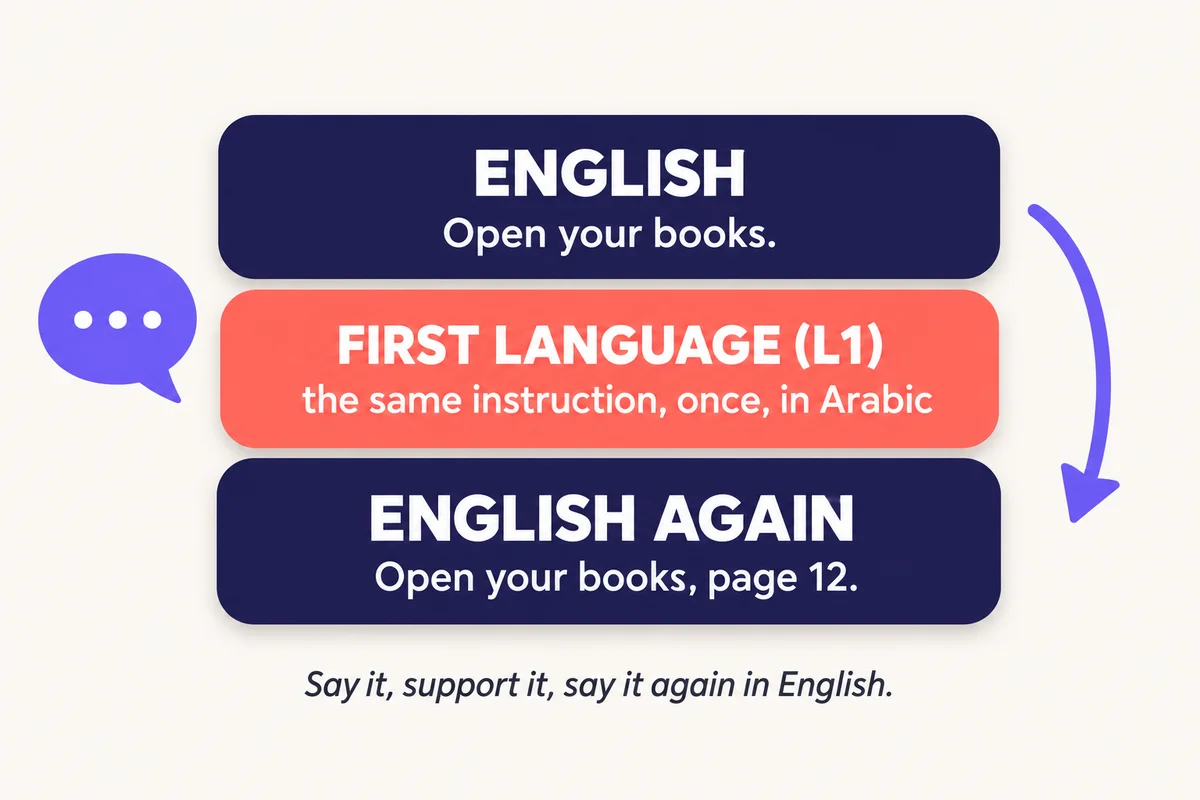
A classic technique here is sandwiching (Dodson, 1972): say it in English, give the Arabic, say it in English again. Open your books. افتحوا كتبكم. Open your books, page 12. The Arabic melts away as the phrase becomes familiar, and the English is what stays.
2. Showing sympathy and empathy
A learner stays behind to tell you her father is in hospital. Another has just failed his university entry exam for the second time. At that moment, carefully graded English is not a gift. It is a barrier.
A sentence in Arabic, خذ وقتك، أنا هنا لو احتجت أي حاجة, does something no A2 English can do: it tells the learner you see them as a person, not a language processing unit. Tekin and Garton's study lists empathy, solidarity and affective support among the real, observed functions of teacher L1 use. Anderson and Kerr point to the same thing from the learner's side: allowing the L1 creates safer speaking environments, which lowers anxiety, and lower anxiety means more learning.
This is not a licence to chat in Arabic all lesson. It is a reminder that you are a human being first and a language model second.
3. Humour that actually lands
You tell a joke in English to a B1 class. Two students laugh, politely, three seconds late. Everyone else is still translating the setup.
Humour is timing, and timing dies in translation. A quick aside in Arabic, يعني اكتشف إنه حجز في المطار الغلط, lands immediately, relaxes the room, and builds the shared warmth that makes learners take risks in English afterwards. In the Turkish study, humour was one of the recurring interpersonal uses of L1, and teachers used it exactly for this: keeping the room human.
4. Idioms and the beauty of "we say that too"
English says to kill two birds with one stone. Egyptian Arabic says يضرب عصفورين بحجر واحد. Same birds, same stone.
That moment of recognition is gold. Lin and Leung (2023) argue that the L1 is a powerful route into idiomatic language, because idioms are where culture lives. When learners discover that the apple of my eye matches قرة عيني, the idiom stops being a strange English decoration and becomes a concept they already own, wearing new clothes.
Try collecting idioms that exist in both languages with your class. Learners love bringing them in, and the L1 is the bridge, not the enemy.
5. Contrastive analysis: using Arabic as a teaching instrument
Your learners share an L1, which means they share the same predictable problems with English. Arabic has one verb where English splits make and do, so make the homework appears every year. Arabic مكتبة covers both library and bookshop, so learners ask to borrow a book from the bookshop. Arabic has no verb to be in the present, so He doctor is waiting patiently in every beginner class.
None of this is laziness. It is transfer, and it is predictable, which means it is teachable. Anderson and Kerr recommend exactly this: short contrastive analysis activities, including work on false friends, where learners compare the two languages and name the trap before they fall into it. Hall and Cook found this kind of cross-language comparison happening in classrooms across 111 countries. It is one of the most widespread core functions of L1 in the world.
Make / do
Arabic uses one verb (يسوي / يعمل) for both. Drill the split with a two-column list: make a mistake, make a decision vs do homework, do exercise. Naming the Arabic reason for the error makes the English rule stick.
Library / bookshop
مكتبة means both. One contrastive question, Do you borrow books or buy them?, separates the two English words in seconds.
The missing "to be"
Arabic drops the present of to be, so learners say She teacher. Show the two sentences side by side, هي مدرّسة and She is a teacher, and let learners see the verb Arabic hides.
6. Instructions at low levels, briefly
For young learners and true beginners, instructions are the most common L1 use in the research (Tekin and Garton, 2020). The judicious version is not translating every instruction. It is giving the instruction in graded English first, then one short Arabic confirmation when the cost of misunderstanding is high, like a test or a safety instruction. Sandwiching lives here too.
Self-check: of the six moments, which one would help your current class most this week?
Pick one and plan exactly where it goes: the word, the learner, or the trap. A planned L1 moment is a technique. The same moment unplanned is a habit.
When L1 holds learners back
Now the honest other half, because the taboo did have a point.
A teacher translates every instruction into Arabic "to be safe". What goes wrong?
Learners stop listening to the English entirely. They wait for the Arabic. The English version becomes background noise, and the one thing the classroom exists to provide, exposure, quietly disappears.
L1 hurts learning when it becomes the default rather than the decision:
- It steals exposure. For many learners, your lesson is the only English they hear all week. Every minute of Arabic you add is a minute of English they lose. That is the strongest argument in the whole English-only tradition, and it never stopped being true.
- It trains waiting. If translation always comes, learners learn to switch off during the English and switch on for the Arabic. You have taught them a strategy, and it is the wrong one.
- It kills guessing. One teacher in Tekin and Garton's study admitted she was spoon-feeding her primary learners: they never had to guess, so they never learned to. Working out meaning from context is a learnable skill, and over-translation unteaches it.
- It shrinks with level, or should. What rescues an A1 lesson can flatten a B2 discussion. Advanced learners need to operate in English, including the difficult moments, because that is the skill.
The teachers who get this wrong are not the ones who use Arabic. They are the ones who use it without deciding to.
So how much L1 is too much in the classroom?
The honest answer from the research: reported amounts vary from 0% to 90% of teacher talk, depending on level, lesson focus and context (Tekin and Garton, 2020). There is no magic percentage, and anyone who sells you one is guessing.
Philip Haines (2014) offers something more useful than a number: three levels of L1 use, from functional (short, controlled moments like word checks and permission to ask in L1), through strategic (contrastive analysis and learning strategies), to discourse (freer bilingual discussion, for confident teachers and classes). You do not have to climb all three. You have to know which level you are operating at and why.
A practical test I give trainees: after the lesson, list every time you used Arabic. Next to each one, write the job it did. If you can name the job, keep it. If the honest answer is "it was easier," that one goes on the cut list for tomorrow.
A simple framework: English by default, L1 by decision
Here is the approach I recommend on CELTA, Practical TEFL and DELTA teacher training courses. Five habits, all learnable in a week.
- Plan the momentsWhile lesson planning, mark the two or three places where Arabic will genuinely help: a hard word, a contrastive point, a complex instruction. Planned L1 is a technique. Unplanned L1 is a habit.
- Signpost itTell the class the rule: English first, Arabic for two seconds when we need it. Learners who know the rule keep listening to the English, because the Arabic is a bonus, not a substitute.
- Keep it shortA word or a sentence, then straight back to English. If your Arabic turn passes twenty seconds, you are probably re-teaching, not translating.
- Bring it back to EnglishAfter the Arabic, anchor in English: the sandwich, an example, a CCQ. The L1 opens the door; English walks through it.
- Fade it outRetire each support as the class grows. By B1, the instruction sandwich goes. By B2, most word checks go. What remains is empathy, humour and the occasional beautiful idiom.
T: You will work in pairs. Student A asks, Student B answers, then swap. Work in pairs. في قروبات من اتنين. In pairs, and you have two minutes.
L: Teacher, what is "swap"?
T: Swap يعني تبدلوا الأدوار. So, Sara asks first, then you swap. What do you do after two minutes, Omar?
Illustrative exchange. One word of Arabic, then the check comes back in English. The L1 did its job in four seconds and left.
Try it tomorrow
Pick one lesson and one technique: the sandwich. Choose three classroom phrases you say every lesson (open your books, work in pairs, you have five minutes). For each one, say it in English, give the Arabic once, and repeat the English.
Do it all week. By Friday, drop the Arabic and watch: the learners still respond. That is the whole philosophy in miniature. The L1 was scaffolding, and scaffolding comes down when the building stands.
Quick answers
Is it wrong to use Arabic in an English lesson?
No. Research over the last two decades shows that judicious L1 use supports learning, especially for checking difficult words, saving time, building rapport, and comparing the two languages. The problem is unplanned overuse, not use itself.
What is judicious use of L1?
Judicious use means short, deliberate L1 moments with a clear learning purpose: a quick translation, a contrastive point, an instruction check or a moment of empathy, followed immediately by a return to English.
How much Arabic should a teacher use in class?
There is no fixed percentage. Studies report anything from 0% to 90% depending on level and context. A better guide: English by default, Arabic by decision, less as the level rises, and every L1 moment should have a job you can name.
What is sandwiching in language teaching?
Sandwiching is saying something in English, giving the L1 equivalent, then repeating the English: "Open your books. افتحوا كتبكم. Open your books." The translation supports understanding while the first and last words learners hear are English.
Why does L1 help with idioms and false friends?
Many idioms exist in both languages with similar images, like "kill two birds with one stone" in Arabic, and shared L1 means shared predictable errors, like "make the homework". Comparing the languages directly turns both into fast, memorable lessons.
Check your understanding
6 short questions. No account needed, no score, and nothing you choose or write is saved or sent anywhere.
Show the answer (no automatic checking)
Answer: B. At low levels a quick L1 translation costs seconds and buys back practice time. Shin, Dixon and Choi (2020) found that five of six vocabulary studies favoured learning words through L1 translation over English-only methods.
By Lumina Trainers
Show the answer (no automatic checking)
Answer: C. Empathy and solidarity are documented functions of teacher L1 use (Tekin and Garton, 2020). Translating everything as routine trains learners to wait for the Arabic and stop listening to the English.
By Lumina Trainers
Show the answer (no automatic checking)
Answer: C. Over-translation teaches waiting, and sudden bans create anxiety. The judicious path is deliberate, signposted L1 use that shrinks as the level rises.
By Lumina Trainers
4 Think back over one lesson this week. List every time Arabic was used, and next to each, the job it did. Which one moment would you keep even in a strict English-only school, and why?
Show a suggested answer
There is no single right list, but strong answers usually protect the human moments (comfort, humour, a fast word check) and cut the routine translation of instructions. If most of your L1 moments have no job you can name, that is the finding: plan two or three deliberate moments and let the rest go.
Suggested answer by Lumina Trainers
5 Choose one predictable Arabic-English trap your learners hit, such as 'make the homework' or the missing 'to be'. Plan a two-minute contrastive activity: what will you show side by side, and what will learners do with it?
Show a suggested answer
A good plan puts the two languages side by side (يسوي for both 'make' and 'do', or هي مدرّسة next to 'She is a teacher'), names the difference in one line, then gives learners a few quick items to sort or correct. Two minutes, in and out, back to English.
Suggested answer by Lumina Trainers
Show the answer (no automatic checking)
Answer: 1–A, 2–B, 3–C. Each L1 moment earns its place only through the job it does for learning. The same moments, used as unplanned routine, are the ones worth cutting.
By Lumina Trainers
Ahmed Bin NasserCELTA Tutor & Teacher Trainer | Lumina
Read next
- Principled Eclecticism in ELT: Beyond the One-Size-Fits-All MethodTeaching Methodology
- Test–Teach–Test (TTT) in ELT: A Practical Guide for CELTA, TEFL and DELTA TeachersTeaching Methodology
- Scaffolding or Spoon-Feeding? How Much Help Is Too Much?Teaching Methodology
- Noticing in ELT: They Saw It. But Did They Actually Notice It?Teaching Methodology