


Bloom's Taxonomy for English Teachers: Six Levels of Thinking, One Lesson
Bloom's taxonomy in plain English for ELT: the six levels, original vs revised, LOTS and HOTS, and one text turned into six classroom tasks.
Your learners got every answer right. But did anyone have to think?
Picture a reading lesson. Learners read a short text about a family moving to Dubai. You ask eight comprehension questions. Where did they move? When? How many children do they have?
Eight questions, eight correct answers. Everyone is happy.
But every answer was a line copied from the text. Nobody compared, judged, chose or made anything. The lesson was correct, and it was thin.
Before you read on: what is the difference between a question learners can answer and a question that makes them think?
A question they can answer may only need them to find and repeat. A question that makes them think asks them to do something with the information: explain it, use it, pull it apart, judge it or build something new. Bloom's taxonomy gives you names for those different jobs.
This is Part 1 of two: the idea, the six levels and what they look like in an English class. In Part 2: Bloom's Taxonomy in Your Lesson Plan, we put it to work on verbs, aims, questions and tasks.
What is Bloom's taxonomy?
Bloom's taxonomy is a way of sorting learning goals by the kind of thinking they ask for, from simple remembering to making something new.
A taxonomy is just a classification: a set of labelled boxes. Benjamin Bloom and four colleagues published this one in 1956, to give teachers and examiners a shared language for what students should be able to do.
Their famous book covers only one of three areas, or domains, of learning.
| Domain | It is about | In an English class |
|---|---|---|
| Cognitive | Thinking and knowing | Understanding a text, choosing the right tense, planning an essay |
| Affective | Feelings, attitudes and values | Willingness to speak, respect for a partner's opinion, confidence |
| Psychomotor | Physical skills | Handwriting in a new script, producing a new sound |
When teachers say "Bloom's taxonomy", they nearly always mean the cognitive domain. So do we.
Why do teachers use it?
- To see what a lesson really demands. Two equally busy tasks can ask for very different thinking.
- To write clearer aims. "Learners will understand the text" is vague. The taxonomy pushes you to say what they will do.
- To vary questions and tasks. It shows you when everything sits on one level.
Original or revised? 1956 and 2001
You'll see two versions. In 2001, a team led by Lorin Anderson and David Krathwohl (one of the original authors) published a revision. Most teachers now use that one.
Before you read on: the 1956 levels are nouns (knowledge, comprehension…). The 2001 levels are verbs (remember, understand…). Why does that small change matter to a teacher?
Because thinking is something learners do. A noun describes a thing a learner has. A verb describes an action you can plan for, set up and watch. You can't see "comprehension", but you can see a learner explain a paragraph in her own words.
| Step | Original (1956) | Revised (2001) | What changed |
|---|---|---|---|
| 1 | Knowledge | Remember | Noun to verb |
| 2 | Comprehension | Understand | Noun to verb, plainer word |
| 3 | Application | Apply | Noun to verb |
| 4 | Analysis | Analyse | Noun to verb |
| 5 | Synthesis | Evaluate | Evaluation moved down one step |
| 6 | Evaluation | Create | Synthesis became Create and moved to the top |
The revision added a second idea: the knowledge dimension. It asks not only how learners think, but what kind of knowledge they are thinking about.
- Factual: separate facts. The past of "go" is "went".
- Conceptual: how ideas connect. How the present perfect differs from the past simple.
- Procedural: how to do something. How to skim a text or lay out a formal email.
- Metacognitive: knowing about your own learning. Which way of recording vocabulary works for me.
The six levels in an English class
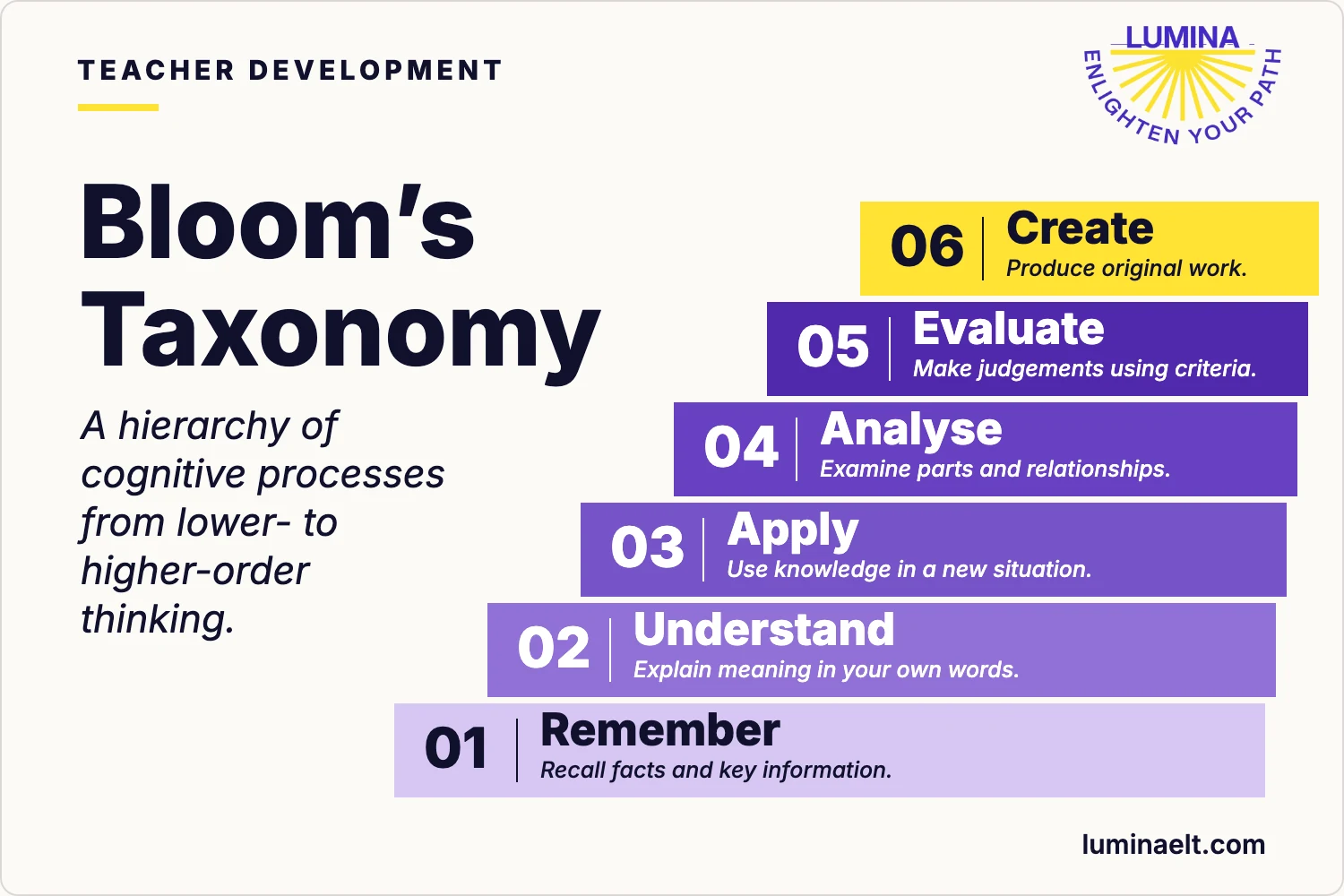
Tap each step to see what it means, what it sounds like in class and a typical task.
01 · Remember
Bring it back from memory. No change, no explanation: just recall or recognise. Sounds like: What's the opposite of "cheap"? What's the past of "buy"? Typical task: match words to pictures, complete a verb table, label a diagram.
02 · Understand
Show you got the meaning. Explain, summarise, give an example or say it another way. Sounds like: So why was she late? Can you say that in your own words? Typical task: put events in order, match headings to paragraphs, summarise for a partner.
03 · Apply
Use it in a new situation. Take the rule, word or strategy and make it work somewhere else. Sounds like: Now tell your partner about your own last weekend. Typical task: a role-play with the new phrases, a personalised gap-fill, writing an email from a model.
04 · Analyse
Take it apart and see how the parts connect. Compare, sort, find the pattern, separate fact from opinion. Sounds like: What's the difference between these two emails? Which sentences are opinions? Typical task: sort examples and work out the rule, compare two texts, find the writer's purpose.
05 · Evaluate
Judge it, and give a reason. Decide what is better, fairer or more useful, against some standard. Sounds like: Which solution is best for this family? Why? Do you agree with the writer? Typical task: rank options and defend the order, check a partner's writing with a checklist.
06 · Create
Put things together to make something new. Plan it, design it, produce it. Sounds like: Design a welcome page for new students. Write a different ending. Typical task: a group poster, a short story, a plan for a class trip, a new quiz for another group.
You already know some of these by other names. Much eliciting is Remember: you pull out what learners know. A good concept-checking question lives at Understand. And guided discovery, where learners study examples and find the rule, is Analyse.
One text, six tasks
The clearest way to see the levels is to keep the text and change the task. Here is an illustrative example of our own.
The text (A2+/B1, about 150 words): "Mona's first week teaching online". Mona, a new teacher in Jeddah, describes her first five days. On Monday her internet cuts out twice. On Tuesday nobody turns a camera on. By Thursday she is using breakout rooms and a shared document, and her learners start to talk. She ends with one thing she'll keep and one she'll change.
| Level | Tasks on the same text | What it demands |
|---|---|---|
| Remember | What happened on Monday? Which two tools did Mona use on Thursday? | Find the line and repeat it |
| Understand | Why did the learners talk more on Thursday? Tell your partner about Mona's week in three sentences. | Connect ideas and say them in your own words |
| Apply | Mona's friend starts online next week. Use the text to give her three tips with should. Then tell your partner about your own first week in a new job or class. | Carry ideas and language into a new situation |
| Analyse | Sort Mona's problems: technology or people? Underline her facts and circle her feelings. What changed between Tuesday and Thursday? | Break the text into parts and find the pattern |
| Evaluate | Which of Mona's decisions was the best one? Why? Is "cameras always on" a fair rule? Agree on an answer in your group. | Judge against a reason, and defend it |
| Create | Write Mona's plan for week two. Or design a one-page "first online lesson" guide for new teachers. | Combine ideas into something that did not exist before |
Nothing in the text changed, only the job we gave the learners. That is task design: purpose first, format second. Part 2 shows how to upgrade a task you already have.
LOTS and HOTS: lower-order and higher-order thinking
Teachers often cut the staircase in two. You'll meet both terms in CLIL and on training courses (more quick definitions in our ELT terminology guide).
- LOTS: lower-order thinking skills
- Remember: recall it
- Understand: explain it
- Apply: use it
- HOTS: higher-order thinking skills
- Analyse: take it apart
- Evaluate: judge it
- Create: make something new
The big misunderstanding: low level, low thinking
Before you read on: your class is A1. Can they evaluate and create, or must that wait until B1?
They can do it now. Your learners are adults, or children with real opinions. Their English is new, but their minds are not. An A1 learner can decide which flat is better, and say big, cheap and because. The thinking is high. Only the language is simple.
Listen to this A1 class looking at pictures of two flats.
T: Flat A or Flat B. Which is better for a family?
L1: Flat B. It is big. It has garden.
T: A garden, nice. Huda, do you agree?
L2: No. Flat A. Flat B is expensive. Flat A is near school.
T: So what is more important for you: big, or near the school?
L2: Near school. Because children walk.
An illustrative exchange, not a transcript of a real lesson.
Tiny sentences, real evaluation: two learners weigh up criteria and defend a choice. Compare these teacher beliefs.
- They're beginners, so I only ask "What colour is it?" They're beginners, so I ask "Which one do you prefer? Why?" and accept a short answer.
- Create tasks are for advanced classes. My A1 class designs a menu for a new café with ten words and a price list.
- I'll make it harder by using a harder text. I'll keep the text and make the thinking richer.
What lower levels need is support for the language: sentence frames, a word bank, a model. That is scaffolding, and it keeps a high-thinking task inside learners' zone of proximal development.
Higher is not always better
Remember and Understand are not "bad" levels. They are the ground floor.
Learners can't compare two emails if they don't understand them. They can't create a menu with no food words.
A lesson that jumps to Create with no language underneath is as weak as one that never leaves Remember.
Is my lesson stuck at the bottom?
Think first: take the last lesson you taught. Write down five questions you asked. Which level is each one?
Don't be surprised if most are Remember and Understand. They are quick, safe and easy to check. If all five sit on the first two steps, your learners spent the lesson finding and repeating. One or two questions higher up would change what they had to do with the language.
Use this short check on any lesson plan.
- Can learners answer most of my questions by finding and repeating a line?No → good. Go to the next question.Yes → you are on the first step. Add one "why" or "in your own words" question.
- Do learners use the new language in a situation of their own?Yes → you have reached Apply. Go to the next question.No → add a personalised or role-play stage before you finish.
- Is there one moment where learners compare, choose, judge or make something?Yes → your lesson climbs. Check that they have the language to do it.No → add one: rank it, choose the best, change the ending.
How do you write those higher questions? That is the question ladder in Part 2.
Common misreadings of Bloom's taxonomy
| Myth | Reality |
|---|---|
| Every lesson must climb all six steps, in order. | It is a map, not a route. A 45-minute lesson may work on two or three levels. You can even start high: a Test–Teach–Test lesson may open with a demanding task and go back to basics afterwards. |
| Put a "higher" verb in the instruction and the task is higher. | Verbs alone fix nothing. "Analyse the text and find three adjectives" is still Remember. Look at what learners really have to do. |
| Each task belongs to exactly one level. | Levels overlap. Writing a review means remembering words, applying grammar, evaluating a film and creating a text, all together. |
| Higher level means harder. | Not always. Remembering 30 irregular verbs is hard. Choosing your favourite of three pictures is easy, and it is evaluation. |
Bloom's taxonomy on CELTA and TEFL courses
"Bloom's taxonomy" is not a CELTA criterion, and nobody will ask you to label your stages. But it helps in three places where trainees often struggle:
- Aims. It moves you from "learners will understand…" to something a tutor can see happening. A useful habit in lesson planning.
- Tasks. It explains why a lesson of three gap-fills feels flat: the format changed, the thinking didn't.
- Questions. It gives you more than "Is that right?" to ask in feedback after tasks: Why? How do you know? Which answer was hardest to agree on?
The practical tools (verb lists by level, aim frames, question ladders and task upgrades) are in Part 2.
You don't need a new coursebook. You need one better question.
Read Part 2: Bloom's in your lesson plan
Frequently asked questions
What is Bloom's taxonomy in simple words?
It is a way of sorting learning goals by the kind of thinking they need, from remembering facts up to creating something new. Teachers use it to check how much thinking their aims, questions and tasks really ask for.
What are the six levels of Bloom's taxonomy?
In the revised version (Anderson and Krathwohl, 2001) they are: remember, understand, apply, analyse, evaluate and create. The first three are often called lower-order thinking skills (LOTS) and the last three higher-order thinking skills (HOTS).
What is the difference between the original and the revised taxonomy?
The 1956 original uses nouns: knowledge, comprehension, application, analysis, synthesis and evaluation. The 2001 revision uses verbs, renames synthesis as create and moves it to the top, above evaluate. It also adds four kinds of knowledge: factual, conceptual, procedural and metacognitive.
Is Bloom's taxonomy used on CELTA and DELTA?
It is not a named CELTA criterion, but it helps trainees write clear aims, vary tasks and ask better questions. At DELTA level it is useful background for discussing aims and task demand, treated critically.
Can beginners do higher-order thinking tasks?
Yes. Language level and thinking level are different things. With simple language and support such as sentence frames, A1 learners can compare, choose, give reasons and make something new.
Keep learning with Lumina
- Bloom's Taxonomy in Your Lesson Plan: Part 2, with verbs, aims, question ladders and task upgrades.
- Task design in ELT: decide what a task is for before you choose its format.
- Eliciting in ELT: draw out what learners know without a guessing game.
- Scaffolding or spoon-feeding?: how to support higher-order tasks without doing the thinking for learners.
- Feedback after tasks: ask "why" and "how do you know", not only "what's the answer".
- ELT terminology, part 1: quick definitions of the terms used here.
References
- Anderson, L. W., & Krathwohl, D. R. (Eds.). (2001). A Taxonomy for Learning, Teaching, and Assessing: A Revision of Bloom's Taxonomy of Educational Objectives. Longman.
- Bloom, B. S. (Ed.), Engelhart, M. D., Furst, E. J., Hill, W. H., & Krathwohl, D. R. (1956). Taxonomy of Educational Objectives: The Classification of Educational Goals. Handbook I: Cognitive Domain. David McKay.
- Coyle, D., Hood, P., & Marsh, D. (2010). CLIL: Content and Language Integrated Learning. Cambridge University Press.
- Cummins, J. (2000). Language, Power and Pedagogy: Bilingual Children in the Crossfire. Multilingual Matters.
- Krathwohl, D. R. (2002). A revision of Bloom's taxonomy: An overview. Theory Into Practice, 41(4), 212–218.
- Krathwohl, D. R., Bloom, B. S., & Masia, B. B. (1964). Taxonomy of Educational Objectives. Handbook II: Affective Domain. David McKay.
Check your understanding
6 short questions. No account needed, no score, and nothing you choose or write is saved or sent anywhere.
Show the answer (no automatic checking)
Answer: C. Learners only find a line and repeat it. That is Remember. A "why" or "in your own words" question would move it to Understand.
By Lumina Trainers
Show the answer (no automatic checking)
Answer: A. The revision uses verbs (remember, understand, apply, analyse, evaluate, create), renames synthesis as create and places it above evaluate. It also adds the knowledge dimension.
By Lumina Trainers
Show the answer (no automatic checking)
Answer: B. False. Language level and thinking level are different. With simple language and support such as sentence frames, A1 learners can compare, choose, give reasons and create.
By Lumina Trainers
Show the answer (no automatic checking)
Answer: 1–B, 2–D, 3–C, 4–A. Planning something new is Create; judging with a reason is Evaluate; sorting into parts is Analyse; using ideas and language in a new situation is Apply.
By Lumina Trainers
Show the answer (no automatic checking)
Answer: D. A new verb does not change the task. Learners still only find and copy words. Look at what learners actually have to do, not at the instruction verb.
By Lumina Trainers
6 Think of the last reading or listening lesson you taught. Which levels did your questions reach, and what is one higher-order task you could add without changing the text?
Show a suggested answer
Many lessons stay at Remember and Understand because those questions are quick and easy to check. You could keep the same text and add one task such as: sort the ideas into two groups (Analyse), choose the best solution and say why (Evaluate), or write a different ending or a short plan (Create). Give a sentence frame or word bank so the language does not block the thinking.
Suggested answer by Lumina Trainers
Ahmed Bin NasserCELTA Tutor & Teacher Trainer | Lumina