


Bloom's Taxonomy in Your Lesson Plan: Verbs, Aims, Questions and Tasks
Use Bloom's taxonomy in your lesson plan: action verbs, observable aims, a six-step question ladder and task upgrades, with classroom examples.
You know the six levels. Now put them to work: in your aims, your questions and your tasks.
Part 2 of 2. New here? Start with Part 1: Bloom's Taxonomy for English Teachers.
A 30-second recap:
- Bloom's taxonomy sorts thinking into six levels.
- Remember → understand → apply → analyse → evaluate → create.
- The first three are often called LOTS (lower-order thinking skills). The last three are HOTS (higher-order thinking skills).
- Lower doesn't mean worse. Higher levels stand on the lower ones.
Now look at this lesson aim. I see it in lesson plans every month:
Students will understand the present perfect.
Stand at the back of that classroom. What would you actually see learners do?
Before you read on: how would you know, by the end of the lesson, that learners "understand the present perfect"?
You can't see understanding. You can only see what learners do: choose the right form in a gap, explain why I've lost my keys is different from I lost my keys, or tell a partner about three things they've done this year.
Each is a different level of thinking. The aim didn't say which one.
Action verbs: your quick reference
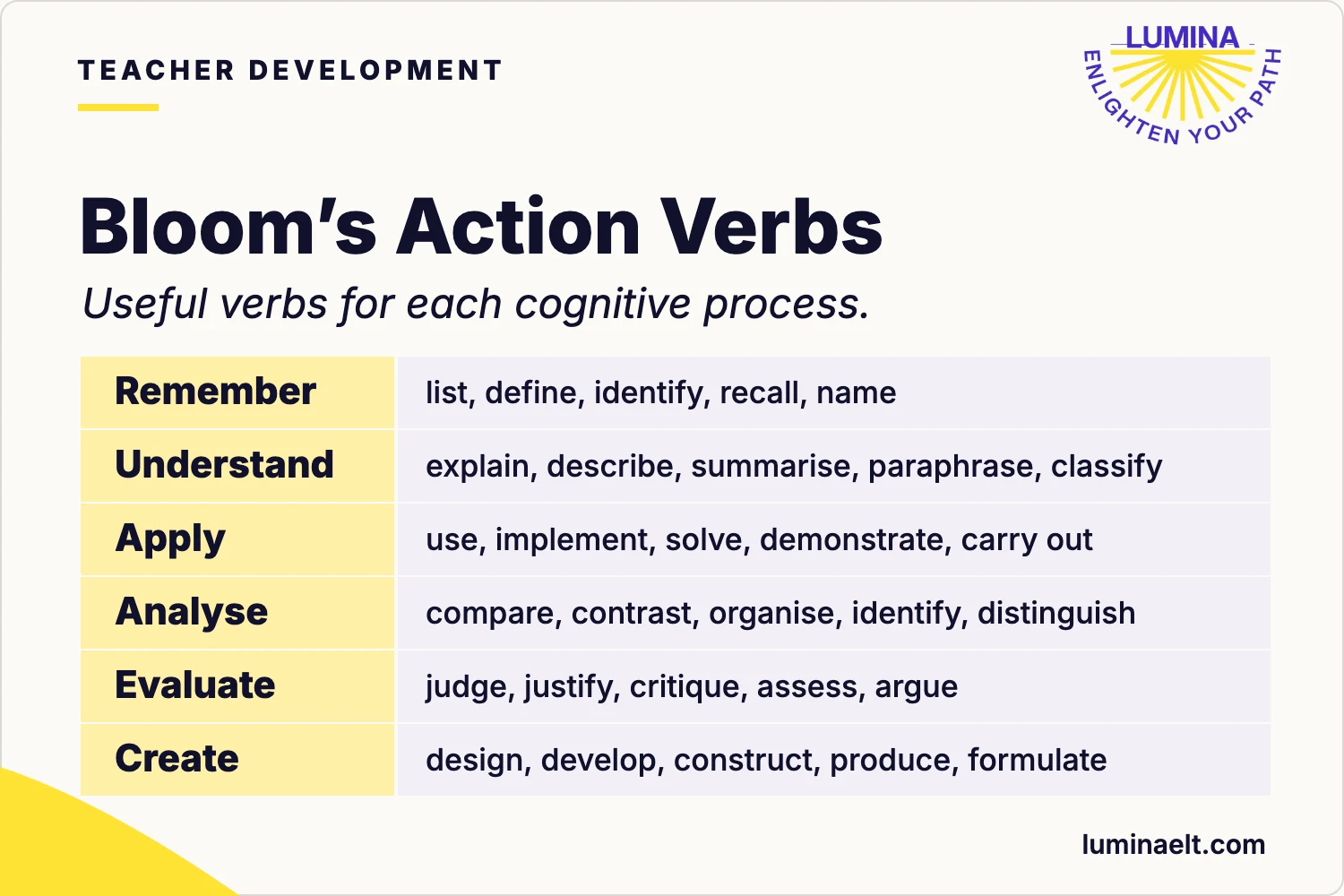
A verb says what the learner will do. Here is our working list for the English classroom.
| Level | Useful verbs | What you'd see in class |
|---|---|---|
| 1. Remember | name, list, label, repeat, recall, spell, match, recognise | Learners label the rooms of a flat from memory. |
| 2. Understand | explain, summarise, paraphrase, give an example, describe, classify, retell | Learners retell a short story in their own words. |
| 3. Apply | use, complete, choose, role-play, ask and answer, write, change, demonstrate | Learners use there is / there are to describe their own flat. |
| 4. Analyse | compare, contrast, sort, find the pattern, distinguish, organise, infer | Learners sort ten sentences into formal and informal, and say how they know. |
| 5. Evaluate | rank, justify, choose and defend, recommend, criticise, assess, decide | Learners rank three flats for a family of five and defend the choice. |
| 6. Create | design, plan, invent, compose, propose, produce, rewrite for a new reader | Learners write an advert for a flat they have designed. |
A warning about verb lists
Verb lists are also a trap. The same verb can sit at different levels.
| Verb | Lower-level use | Higher-level use |
|---|---|---|
| identify | Identify the past simple verbs in the text. (remember) | Identify the writer's attitude from her word choice. (analyse) |
| compare | Compare your answers with a partner. (no new thinking) | Compare two emails and decide which is more polite, and why. (analyse, evaluate) |
| explain | Explain the rule we wrote on the board. (remember) | Explain why the speaker changed tense in line 4. (analyse) |
Writing lesson aims with Bloom's
A good aim is observable. Someone watching your lesson could tick it or cross it. (For the full picture of aims and stages, see our lesson-planning guide.)
Compare these pairs:
Students will understand the present perfect. Learners will be better able to use the present perfect to talk about life experiences in a "find someone who" survey.
Students will know about formal emails. Learners will be better able to distinguish formal from informal email phrases and rewrite an informal email for a manager.
Avoid the invisible verbs: understand, know, learn, be aware of.
- By the end of the lesson…Start from the finish line, not from your activities.
- …learners will be better able to…"Better able" is honest. One lesson improves a skill; it rarely completes it.
- …verb + content…One observable verb from the table, plus the language or skill.
- …in a context, with evidence.Where will you see it? A role-play, a paragraph, a ranking, a survey.
| Vague aim | Observable aim | Level |
|---|---|---|
| To teach comparatives | Learners compare two phones using six comparative adjectives | Apply |
| To practise reading | Learners separate facts from opinions in a hotel review | Analyse |
| To do a speaking activity | Learners choose the best of three candidates for a job and justify the choice | Evaluate |
| To cover the vocabulary of weather | Learners name eight weather words from pictures | Remember |
Notice the last row. A "remember" aim isn't a bad aim. It's an honest one.
The question ladder
Your questions set the thinking level of the room, minute by minute.
Think first: your class has read a short article about a café that bans laptops at weekends. Write one question that needs only memory, and one that needs judgement.
Memory: On which days are laptops not allowed? The answer is in the text. Judgement: Is the rule fair to students? The answer is in the learner's head, and they must defend it.
1 · Remember
On which days are laptops not allowed?
Demands: find and repeat a fact from the text.
2 · Understand
Why did the owner make this rule? Tell me in your own words.
Demands: process the meaning and rephrase it, not copy it.
3 · Apply
Your favourite café starts the same rule next Saturday. What do you do?
Demands: carry the idea into a new, personal situation.
4 · Analyse
Which sentences are facts, and which are the owner's opinion? How do you know?
Demands: break the text into parts and see how it is built.
5 · Evaluate
Is the rule fair to students with nowhere quiet to study? Give two reasons.
Demands: make a judgement and support it.
6 · Create
Write a new rule that keeps the owner and the students happy.
Demands: produce something that wasn't in the text.
Here is how the climb can sound in a B1 class (an illustrative exchange):
T: So, when can't you use a laptop there?
L1: Friday and Saturday.
T: Right. And why? In your words, Huda.
L2: Because people sit long time and buy only one coffee.
T: OK. Is that fair to students?
L2: No! Students need place for study.
L3: But it's his café. Maybe… two hours is OK, then you buy again?
T: Interesting. That's a new rule. Pairs: write your own rule. Two minutes.
A fact, a reason, a judgement, then a new idea. Note what she did not do: stop to correct sit long time. She saved the language for later feedback.
Lower questions still matter. Concept checking questions usually sit at "understand" on purpose, because their job is to check meaning. And good eliciting often starts with what learners remember.
Upgrade a task: same material, three versions
You don't need new materials. You need a new instruction. Take one coursebook page: eight items for a camping trip (tent, torch, sleeping bag, matches, map, first-aid kit, rope, water bottle).
- Before: matchMatch the eight words to the pictures. Level: remember. Evidence: correct lines on the page.
- After 1: rank and justifyYou can take only four items to the desert in January. Agree with your partner which four, and why. Level: evaluate.
- After 2: designPlan a packing list for a different trip: a family with a baby, one night by the sea. Add three new items and present your list. Level: create.
Same words. But in versions two and three learners need them to do something, so they say them many more times.
To upgrade any task, change one thing:
| Change one thing | From | To |
|---|---|---|
| The verb | Complete the sentences | Choose the two most useful sentences for a tourist and say why |
| The outcome | Ten correct answers | One decision, list or plan the pair must agree on |
| The interaction | Alone, then check | Pairs with different information who must reach agreement |
| The evidence | A tick | A reason: "because…" |
The cheapest upgrade is one word: "Why?" For more, read Task design in ELT: purpose before format.
Low language level doesn't mean low thinking
Teachers often tell me: "My students are beginners. They can't do higher-order thinking."
They can. They have full minds and a small amount of English. Keep the language simple and let the thinking rise.
Think first: how could an A1 learner "evaluate" using only I like…, because and good / bad / cheap / expensive?
Show three lunch menus with prices. Ask: Which is the best lunch for a student? Why? The answer Number two, because it's cheap and good is real evaluation in seven words.
| Level | A1–A2 task | B1–B2 task |
|---|---|---|
| Analyse | Sort twelve food pictures into "healthy" and "not healthy". | Read two product reviews and find the words that show each writer's attitude. |
| Evaluate | Choose the best of three weekend plans for your family. Say I think… because… | Rank four solutions to traffic in your city. |
| Create | Draw and label your ideal room. Tell your partner: There is… There are… | Design a one-day tour of your city for visitors and present it. |
The support makes it possible: pictures, a model, sentence frames on the board. That is scaffolding, not spoon-feeding. You carry part of the language load so learners can carry the thinking.
Bloom's across lesson types
Every lesson type has a favourite level. Know the habit, then lift it once.
| Lesson type | Where thinking usually stays | One way to lift it |
|---|---|---|
| Grammar | Remember the rule, apply it in gaps | Learners work out the rule from examples, or explain why two forms differ (analyse) |
| Vocabulary | Remember and match | Sort words by connotation, or choose the best word for a context and defend it (analyse, evaluate) |
| Reading and listening | Understand: comprehension questions | Fact or opinion? Do you trust this speaker? What is missing? (analyse, evaluate) |
| Speaking | Apply: role-plays from a model | Give the task an outcome: agree, rank, solve, decide (evaluate) |
| Writing | Apply: copy the model text | Compare two models first, then write for a new reader with a new purpose (analyse, create) |
Stages and levels: how a lesson moves
Thinking levels often rise as a lesson goes on. Here is a typical language lesson.
| Stage | Typical levels |
|---|---|
| Lead-in | Remember, understand (sometimes evaluate) |
| Clarification | Understand, analyse |
| Controlled practice | Apply |
| Freer practice | Apply, evaluate, create |
| Feedback | Analyse, evaluate |
A caution: this is a pattern, not a rule. A lead-in can open with a strong opinion question. In a task-based lesson, learners may "create" in the first ten minutes and analyse language afterwards. The levels don't have to climb in order.
Is this task at the right level?
Use this flow while you plan.
- Does the task match the verb in your aim?Yes → next question.No → change the task, or be honest and change the aim.
- Will you see or hear evidence of the thinking?Yes → next question.No → add an outcome: a ranking, a reason, a product.
- Do learners have the foundations (the words, the form, the facts)?Yes → next question.No → add a lower-level step first.
- Are the language load and the thinking load both high?Yes → lower one. Give frames, a model or planning time.No → the level is right. Teach it.
The fourth question is the one teachers miss. A task in the learners' Zone of Proximal Development is one they can do with support. New grammar, new vocabulary and a hard judgement together usually fall outside it.
Bloom check in two minutes
Your plan is finished. Before you print it:
- Circle the verbsIn your main aim and every stage aim. Any "understand" or "know"? Replace it.
- Label each taskWrite R, U, Ap, An, E or C beside every task. Judge the thinking, not the instruction verb.
- Look at the patternAll R and U? Lift one task. All E and C? Check the foundations are there.
- Find the evidenceWhere will you see the main aim achieved? Which stage, which learners, what will they say or write?
- Write two questionsTwo higher-order questions, word for word, in the plan.
- Check the loadFor your highest task, what support carries the language?
Then, in the lesson, monitor for that evidence. Listen for the reasons learners give, not only for the right answers.
Common mistakes and how to fix them
Think first: a teacher changes her aim from "understand the passive" to "analyse the passive", but the lesson is the same gap-fill. What has improved?
Nothing, except the paperwork. This is verb decoration, the first mistake in the table below. The plan looks higher. The learners' thinking hasn't moved.
| Mistake | Fix |
|---|---|
| Verb decoration | Change the task first, then write the verb that describes it |
| All HOTS, no foundations | Build the lower steps first: the vocabulary, a model, some ideas |
| Difficulty mistaken for complexity | More of the same is harder work, not higher thinking. Change the kind of thinking |
| Hard thinking + hard language together | Lower one load: sentence frames, planning time, a familiar topic |
| No evidence | Give every higher task a visible outcome |
A note for CELTA trainees
On CELTA, your tutors look closely at three things that Bloom's helps with:
- Main aims: clear, and stated as what learners will be better able to do.
- Stage aims: each stage has a reason, and the reasons add up to the main aim.
- Task variety: the lesson doesn't repeat one kind of thinking for forty-five minutes.
You don't need to write Bloom's levels in a CELTA plan, and nobody will ask you to. Use them privately, as a check. You'll find more planning terms in ELT Terminology, Part 2.
Quick FAQs
How do I use Bloom's taxonomy in a lesson plan?
Use it as a check, not a template. Write an observable main aim, label the thinking level of each task, and make sure at least one task asks learners to analyse, evaluate or create with support.
Which verbs should I use for lesson aims?
Verbs you can see or hear: name, describe, use, compare, rank, justify, design. Avoid understand, know and learn as main verbs, because nobody can observe them.
Can I use Bloom's taxonomy with beginners?
Yes. Keep the language simple and support it with pictures, models and sentence frames. A beginner can sort, choose the best option and give a reason with "because".
Does every lesson need all six levels?
No. A lesson needs the levels its aim requires. One lesson may focus on two or three; across a unit, learners should meet all six.
What is the difference between LOTS and HOTS questions?
LOTS questions ask learners to recall, explain or use what they were given. HOTS questions ask them to break it down, judge it or make something new, so there is usually more than one acceptable answer.
Keep learning with Lumina
- Bloom's Taxonomy for English Teachers (Part 1): the six levels, the history and LOTS and HOTS explained.
- Lesson planning: where aims, stage aims and tasks fit together.
- Task design in ELT: decide what a task is for before you choose its format.
- Scaffolding or spoon-feeding?: how to support hard thinking without doing it for learners.
References
- Anderson, L. W., & Krathwohl, D. R. (Eds.) (2001). A Taxonomy for Learning, Teaching, and Assessing: A Revision of Bloom's Taxonomy of Educational Objectives. Longman.
- Biggs, J. (1996). Enhancing teaching through constructive alignment. Higher Education, 32(3), 347–364.
- Biggs, J. B., & Collis, K. F. (1982). Evaluating the Quality of Learning: The SOLO Taxonomy. Academic Press.
- Bloom, B. S., Engelhart, M. D., Furst, E. J., Hill, W. H., & Krathwohl, D. R. (1956). Taxonomy of Educational Objectives: The Classification of Educational Goals. Handbook I: Cognitive Domain. David McKay.
- Krathwohl, D. R. (2002). A revision of Bloom's taxonomy: An overview. Theory Into Practice, 41(4), 212–218.
Check your understanding
6 short questions. No account needed, no score, and nothing you choose or write is saved or sent anywhere.
Show the answer (no automatic checking)
Answer: C. "Understand" is invisible. A stronger aim says what learners will do and where you will see it, for example: use the second conditional to give advice in a problem-page role-play.
By Lumina Trainers
Show the answer (no automatic checking)
Answer: A. Ranking and justifying is evaluation. Faster or longer matching is more difficult, but it is the same kind of thinking.
By Lumina Trainers
Show the answer (no automatic checking)
Answer: B. False. "Compare your answers with a partner" needs no new thinking. The task decides the level, not the verb.
By Lumina Trainers
Show the answer (no automatic checking)
Answer: 1–C, 2–D, 3–A, 4–B. Finding a fact is remembering. Separating fact from opinion is analysis. Judging fairness with reasons is evaluation. Writing a new rule is creating.
By Lumina Trainers
Show the answer (no automatic checking)
Answer: D. The thinking load and the language load were both high. Build the lower steps first (vocabulary, a model, ideas) and give sentence frames or planning time.
By Lumina Trainers
6 Take one task from a lesson you taught this week. Which level of thinking did it really demand, and what one change (verb, outcome, interaction or evidence) would lift it one level?
Show a suggested answer
Example: my vocabulary gap-fill was "apply" at best, and learners could finish it by guessing. I would change the outcome: after the gap-fill, pairs choose the three most useful words for a job interview and give a reason for each. That moves it to "evaluate", gives me evidence I can hear while monitoring, and needs only one sentence frame on the board: "We chose … because …".
Suggested answer by Lumina Trainers
Ahmed Bin NasserCELTA Tutor & Teacher Trainer | Lumina