


CELTA Assignment 1: Focus on the Learner — Understand the Learner, Not Just the Error
Understand Focus on the Learner: gather learner evidence, identify language and skills needs, choose activities and justify your decisions without model answers.
CELTA Hub / 01
A learner profile is not the same thing as understanding a learner.
You've interviewed your learner. You've collected a language sample. You've found several errors. But have you worked out what would actually help that person learn? That's where Focus on the Learner becomes interesting.
Check your own brief first. Cambridge sets the assessment scope; your centre designs the assignment. The order and format may vary. Each of the four assessed assignments is normally 750–1,000 words; follow your centre's word-count instructions. This guide is for preparation, not a model submission.
What is CELTA Assignment 1 looking for?
This assignment asks you to investigate a learner or group of learners in context, identify relevant needs and select resources or activities that address them. Your choices need a reason. A collection of biographical facts, however accurate, does not establish a teaching priority.
Start with the learner, not the reference book
Investigate why they are learning English, where they use it, what they have studied before and what helps or limits their participation. Learning preferences are worth exploring, but avoid turning them into fixed learning-style labels. Gather samples in accordance with your brief, protect personal information and distinguish your observation from the learner's own report.
Your learner says speaking is difficult. Is that enough evidence?
It is a useful starting point, not a diagnosis. Investigate what happens in relevant speaking situations and consider what the evidence suggests before selecting a priority.
Evidence, interpretation, decision
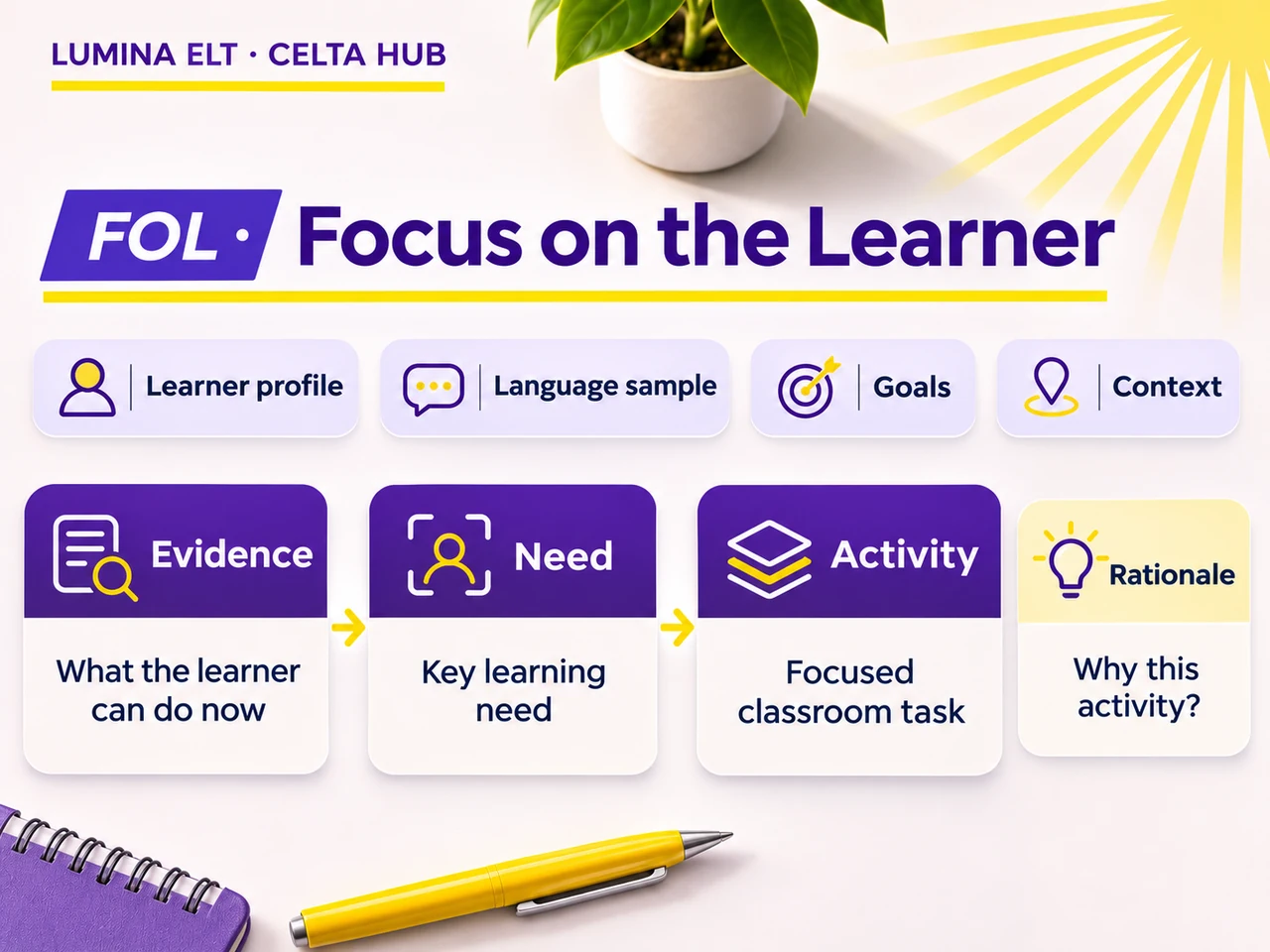
- Observe
- Use actual performance and learner information.
- Interpret
- Identify a specific language or skills need.
- Respond
- Choose appropriate material and explain why.
A recurring problem and a one-off slip are not necessarily the same. Consider whether the issue affects communication, whether the learner can self-correct, and what you can reasonably infer. Use precise terminology: grammar, lexis, phonology or a specific skill or subskill. Our guide to purposeful monitoring can help you think about the evidence.
Do not assume a difficulty simply because of the learner's first language. A reference book can suggest possibilities, but the sample should establish whether they matter for this learner.
Choose a resource because it serves a need
Before selecting an activity, ask what the learner needs to do differently. Is the level suitable? Does it target the actual difficulty? Can the learner use what is practised beyond the exercise? Your rationale should make the connection between the evidence, the activity and its intended benefit clear. If your centre asks for an adapted activity or materials, label and cross-reference them. Read our article on purposeful task design for the underlying principle.
Books worth opening
- Learner English — edited by Michael Swan and Bernard Smith: investigate possible L1-related difficulties.
- Learning Teaching — Jim Scrivener: practical activity and skills methodology.
- How to Teach English — Jeremy Harmer: classroom practice and teaching choices.
Use the index or search function to locate the relevant topic, then read in context and cite the specific source you consulted. These are reading suggestions, not a ready-made bibliography.
Before you submit
- Have I shown how background or experience matters for learning?
- Can I trace each identified need to evidence?
- Have I used accurate ELT terminology?
- Do the selected resources address those needs, with a rationale?
- Have I acknowledged sources and protected learner information?
Check your work against each criterion, not just the title of the task. For referencing, appendices and word-count advice, see our CELTA academic writing guide. Allow time to proofread and meet your deadline.
If you are asked to resubmit
Return to the evidence first. A tutor may ask for a clearer diagnosis, a better matched activity or a more explicit rationale. Treat those comments as priorities, not a verdict on your ability to teach. Work on the indicated points and ask for clarification if needed.
Explore the CELTA Hub
Continue with the other guides in our CELTA assignments series:
- Assignment 2: Language Related Tasks
- Assignment 3: Language Skills Related Tasks
- Assignment 4: Lessons from the Classroom
- Academic writing, APA referencing and submission tips
Check your understanding
6 short questions. No account needed, no score, and nothing you choose or write is saved or sent anywhere.
Show the answer (no automatic checking)
Answer: B. Evidence grounds your interpretation; background reading can help investigate it.
By Lumina Trainers
Show the answer (no automatic checking)
Answer: A. A rationale links the activity to a specific need and expected benefit.
By Lumina Trainers
Show the answer (no automatic checking)
Answer: C. An isolated slip may not indicate a stable learning need.
By Lumina Trainers
Show the answer (no automatic checking)
Answer: B. Protect learners and report only authentic evidence.
By Lumina Trainers
Show the answer (no automatic checking)
Answer: 1–B, 2–C, 3–A. Each has a different role.
By Lumina Trainers
6 Look at your own learner evidence. What do you still need to find out before selecting an activity?
Show a suggested answer
Identify a genuine gap in your evidence and decide how to investigate it within your brief.
Suggested answer by Lumina Trainers
Ahmed Bin NasserCELTA Tutor & Teacher Trainer | Lumina
Read next
- CELTA Assignment 2: Language Analysis — Knowing English Isn't the Same as Analysing ItCELTA Hub
- CELTA Assignment 3: Language Skills — A Good Text Doesn't Automatically Make a Good LessonCELTA Hub
- CELTA Assignment 4: Lessons from the Classroom — Reflection Is More Than Listing Your StrengthsCELTA Hub
- You've Written Your CELTA Assignment. Is It Really Ready to Submit?CELTA Hub