


You've Written Your CELTA Assignment. Is It Really Ready to Submit?
Learn academic prose, APA citations, quotations, bibliographies, cross-referencing, appendices, word counts and submission checks for CELTA assignments.
CELTA Hub / 05
You've finished writing. But is your assignment ready for your tutor to read?
You have a bibliography, a few worksheets at the end and a word count that looks about right. Academic writing is not about making the file look impressive. It is about communicating your understanding clearly and making your evidence easy to follow.
Academic prose: clarity before complexity
Write coherent sentences and connected paragraphs. Introduce a point, develop it through explanation or evidence, and connect it to your reasoning where appropriate. Avoid unnecessary jargon, vague generalisations and chatty language. First person can be appropriate for reflection. Cambridge requires at least two written assignments in academic prose; the centre may use other formats for the remaining tasks.
In-text citations and APA referencing
When an idea comes from a source, acknowledge it where you use it, including when paraphrasing. Cambridge's guidance recommends APA for CELTA and DELTA but permits other recognised styles. Follow your centre's policy consistently.
- In-text
- Swan and Smith (2001), or (Swan & Smith, 2001)
- Reference list
- Full publication details for the cited work.
The example above refers to the edited book as a whole. If using a chapter with its own author, cite and reference the chapter author. For an APA short direct quotation, use the actual exact words in quotation marks and include author, year and page number, e.g. (Author, Year, p. X). These are format placeholders, not a quotation to copy. APA uses block formatting for quotations of 40 words or more; avoid lengthy quotations in a short assignment. For paraphrases, a page number is optional in APA but helpful for locating a particular passage; check your centre's rules.
Bibliography or reference list?
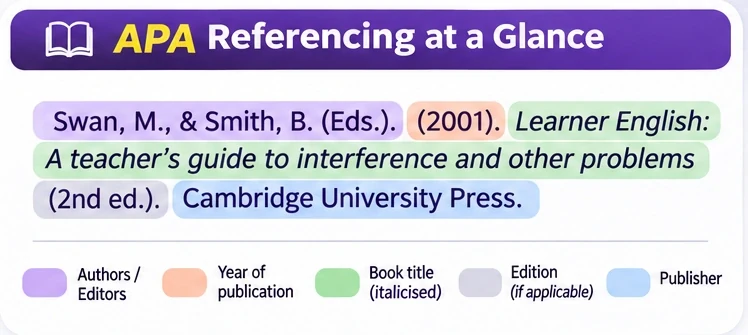
An APA reference list includes the works cited in the text. A bibliography can include wider consulted material, depending on your centre's instructions. Here is an example of a print edited-book reference in APA 7:
Swan, M., & Smith, B. (Eds.). (2001). Learner English: A teacher's guide to interference and other problems (2nd ed.). Cambridge University Press.
Use alphabetical order and hanging indents for an APA reference list. Check your actual edition and include a DOI where applicable. Do not cite a source you have not consulted.
Cross-referencing and appendices
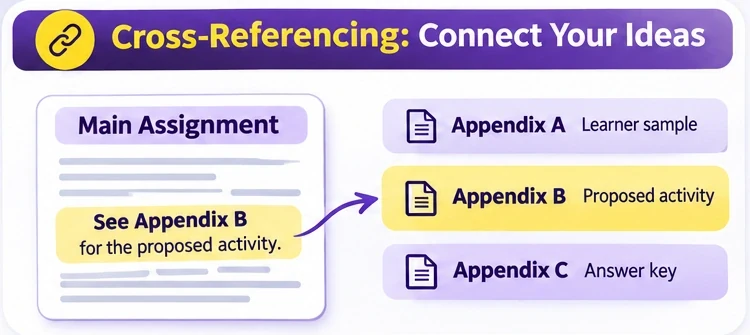
Cross-referencing connects a statement in the main body to relevant supporting material. For instance, See Appendix B, Task 2 tells the reader exactly where to find the activity discussed. A reference list identifies published sources; a cross-reference identifies another part of your document. Both make evidence traceable.
- Main text
- See Appendix B, Task 2.
- Appendix B
- Proposed activity — Task 2.
Appendix is singular; appendices is plural. Label and title each one, refer to it in the body, and include only relevant materials. An appendix may contain a learner sample, a text, an activity, an answer key or an observation record if required. Do not hide essential analysis there to evade the word limit. Anonymise learner details and acknowledge reproduced materials.
You've attached a worksheet, but never mention it in the assignment. Is the reader expected to work out why it's there?
No. Cross-reference it at the relevant point and explain why it is relevant. Recheck numbering after editing.
Presentation: do's and don'ts
Use a readable, consistent font, logical headings, paragraph spacing and page numbers where required. Bold is useful for headings or labels; italics are used for book titles and may distinguish language examples. Avoid excessive colours, decorative fonts and whole paragraphs in bold. If your centre specifies a resubmission colour or template, follow it.
How to check the word count in Microsoft Word
Each CELTA written assignment is normally 750–1,000 words. Establish what your centre includes: template prompts, tables, quotations, headings, references and appendices may be treated differently. In desktop Word, select the relevant text and read the selected word count on the status bar, or use Review > Word Count. If eligible content is scattered, copy only that material into a temporary separate document and count it there. Check that nothing required is accidentally omitted.
Find the right page, not just the right book
Use the contents page and index of a printed book, or Ctrl + F (Windows) / Command + F (Mac) in searchable digital material. Try alternate terms and read around the result. Record author, edition, publication year and pages while researching. Keep your own notes separate from quotations.
Before you submit
- Check the brief against every assessment criterion.
- Check every in-text citation against your reference list and every appendix label against the main text.
- Check the word count, formatting, file name and deadline.
- Ensure the work is your own and follow your centre's academic integrity and AI policy; acknowledge any permitted AI use.
If you may miss a deadline, contact the tutors early rather than assume an extension.
Resubmission: take the feedback seriously, not personally
If asked to resubmit, identify the particular criteria your tutor wants you to address. Read the guidance, revise the relevant points and meet the revised deadline. You are learning to communicate professional knowledge as well as to teach. A request for revision is not a judgement on your potential.
Official guidance
Cambridge CELTA syllabus and assessment guidelines · Cambridge guidance on generative AI in assessed work.
Explore the CELTA Hub
Continue with the other guides in our CELTA assignments series:
- Assignment 1: Focus on the Learner
- Assignment 2: Language Related Tasks
- Assignment 3: Language Skills Related Tasks
- Assignment 4: Lessons from the Classroom
Check your understanding
6 short questions. No account needed, no score, and nothing you choose or write is saved or sent anywhere.
Show the answer (no automatic checking)
Answer: A. The origin of the idea still needs acknowledgement.
By Lumina Trainers
Show the answer (no automatic checking)
Answer: A. Cross-references locate relevant material within the document.
By Lumina Trainers
Show the answer (no automatic checking)
Answer: B. The document total may include excluded material.
By Lumina Trainers
Show the answer (no automatic checking)
Answer: B. Every cited work should have an appropriate corresponding reference entry.
By Lumina Trainers
Show the answer (no automatic checking)
Answer: 1–B, 2–C, 3–A. Each has a different role.
By Lumina Trainers
6 How will you check that your evidence, sources and word count are accurate before submission?
Show a suggested answer
Build a brief personal review routine based on your centre's actual instructions.
Suggested answer by Lumina Trainers
Ahmed Bin NasserCELTA Tutor & Teacher Trainer | Lumina
Read next
- CELTA Assignment 1: Focus on the Learner — Understand the Learner, Not Just the ErrorCELTA Hub
- CELTA Assignment 2: Language Analysis — Knowing English Isn't the Same as Analysing ItCELTA Hub
- CELTA Assignment 3: Language Skills — A Good Text Doesn't Automatically Make a Good LessonCELTA Hub
- CELTA Assignment 4: Lessons from the Classroom — Reflection Is More Than Listing Your StrengthsCELTA Hub