


CELTA Assignment 3: Language Skills — A Good Text Doesn't Automatically Make a Good Lesson
Understand CELTA receptive and productive skills, text selection, task design, subskills, and pedagogical rationale for the Language Skills assignment.
CELTA Hub / 03
An interesting text is a good start. It isn't the learning aim.
You've found a text, prepared some comprehension questions and added a discussion. What will learners actually get better at? If you cannot answer that question, the tasks may be driving the lesson instead of the learning purpose.
Check your own brief first. Cambridge sets the assessment scope; your centre designs the assignment. The order and format may vary. Each of the four assessed assignments is normally 750–1,000 words; follow your centre's word-count instructions. This guide is for preparation, not a model submission.
What is the language skills assignment?
The assignment asks you to use relevant background reading to identify opportunities to develop receptive and productive language skills with a text, and to design related tasks with a brief rationale. The text may be supplied or selected according to your centre's instructions. Don't assume every centre requires the same lesson stages.
Skills and subskills: choose accurate labels
Reading and listening are receptive skills; speaking and writing are productive. In reading, skimming can help learners establish the overall idea, while scanning helps them locate specific information. Reading for detailed understanding, inferring meaning or recognising a writer's stance serve different purposes. Listening for overall meaning, specific information, detail or inference also involves different demands. Avoid using terminology as interchangeable labels.
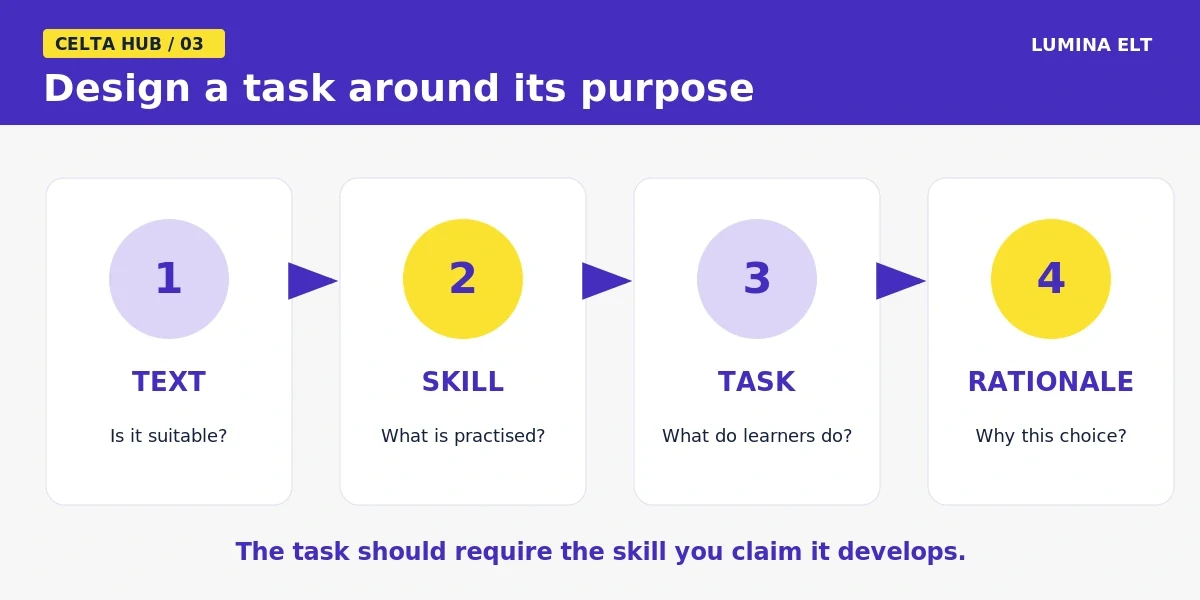
- Text
- Consider level, relevance and context.
- Skill
- Identify what learners need to practise.
- Task
- Create a reason to use that skill.
- Rationale
- Explain why the task serves the aim.
Learners can answer all your questions by reading the first line. Does that make it a successful detailed-reading task?
Not necessarily. The answers might be easy to locate without detailed processing. Check what the questions actually require learners to do.
Make your task fit the skill
Evaluate the text's demands, the learners' level, the task instructions and how much time learners need. A challenging text may still be usable with an accessible task. A familiar topic does not guarantee an appropriate text. Think about whether the task encourages meaningful processing rather than translation of every word. Read our task design guide for ways to evaluate difficulty.
Staging is a decision, not a recipe
A lead-in can establish interest or context. Pre-teaching selected vocabulary can remove a genuine barrier. Different reading or listening tasks may serve different purposes, and a productive follow-up can exploit the content in meaningful communication. But check the brief: one centre may require a lead-in and another may ask only for selected tasks. Do not add stages merely because a framework includes them.
Your rationale should tell the reader why the selected task helps develop the stated skill with these learners. For speaking or writing, make clear the communicative purpose rather than simply saying that the task is productive. Plan feedback appropriate to the purpose; see feedback after tasks.
Books for receptive and productive skills
- Teaching Reading Skills in a Foreign Language — Christine Nuttall: reading purposes and processes.
- How to Teach Listening — J. J. Wilson; Listening in the Language Classroom — John Field: listening methodology.
- Learning Teaching — Jim Scrivener; How to Teach English — Jeremy Harmer: skills work and lesson design.
Research the subskill you intend to develop. Cite the source in your rationale and cross-reference any text, task or answer key in the appropriate appendix, respecting copyright and centre requirements.
Before you submit
- Does my text meet the selection requirements?
- Do my tasks actually practise the subskills I name?
- Have I explained the rationale rather than just describing the procedure?
- Have I included productive skills and required materials?
- Are the appendices, citations and answer keys clear where required?
Check your work against each criterion, not just the title of the task. For referencing, appendices and word-count advice, see our CELTA academic writing guide. Allow time to proofread and meet your deadline.
If your skills assignment comes back
Don't immediately search for a new text. The feedback may relate to the questions, the selected subskill or the rationale. Work out which decision needs to change. A targeted revision often makes more sense than rebuilding the entire assignment.
Explore the CELTA Hub
Continue with the other guides in our CELTA assignments series:
- Assignment 1: Focus on the Learner
- Assignment 2: Language Related Tasks
- Assignment 4: Lessons from the Classroom
- Academic writing, APA referencing and submission tips
Check your understanding
6 short questions. No account needed, no score, and nothing you choose or write is saved or sent anywhere.
Show the answer (no automatic checking)
Answer: B. Task design begins with a learning purpose.
By Lumina Trainers
Show the answer (no automatic checking)
Answer: A. Scanning is selective reading for particular information.
By Lumina Trainers
Show the answer (no automatic checking)
Answer: C. Centres may use different assignment formats.
By Lumina Trainers
Show the answer (no automatic checking)
Answer: A. Speaking or writing should have an identifiable purpose.
By Lumina Trainers
Show the answer (no automatic checking)
Answer: 1–C, 2–A, 3–B. Select the term that matches what the reader actually does.
By Lumina Trainers
6 What does one task in your own assignment require learners to do, and how could you tell if it serves the skill aim?
Show a suggested answer
Evaluate the task demands against your intended aim; make your own rationale based on evidence.
Suggested answer by Lumina Trainers
Ahmed Bin NasserCELTA Tutor & Teacher Trainer | Lumina
Read next
- CELTA Assignment 1: Focus on the Learner — Understand the Learner, Not Just the ErrorCELTA Hub
- CELTA Assignment 2: Language Analysis — Knowing English Isn't the Same as Analysing ItCELTA Hub
- Concept checking questions (CCQs): what they are, examples, and how to write themClassroom skills
- The lead-in: how to start an English lesson so the rest of it worksClassroom skills