


CELTA Assignment 2: Language Analysis — Knowing English Isn't the Same as Analysing It
A practical guide to CELTA language analysis: meaning, form, pronunciation and use, accurate ELT terminology, reference books and common pitfalls.
CELTA Hub / 02
You can use a language item perfectly well and still struggle to explain it.
That's normal. Language Related Tasks are not a test of whether you can recite a grammar book. They are a chance to examine language closely enough to teach it accurately. A rule you remember from school may not explain the particular example in front of you.
Check your own brief first. Cambridge sets the assessment scope; your centre designs the assignment. The order and format may vary. Each of the four assessed assignments is normally 750–1,000 words; follow your centre's word-count instructions. This guide is for preparation, not a model submission.
What does language analysis involve?
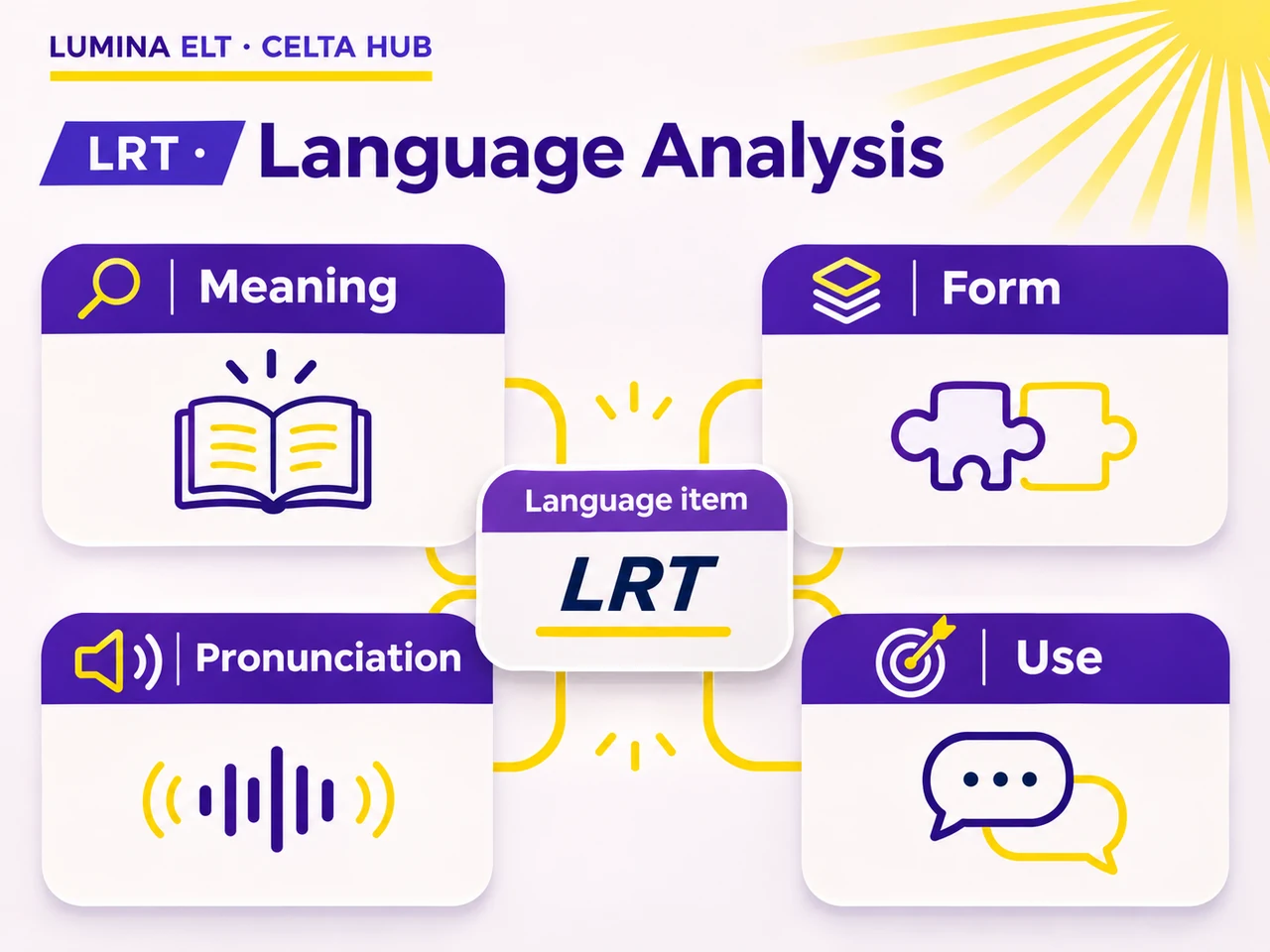
The assignment focuses on significant features of English language items and appropriate reference material. You may be given contextualised sentences, vocabulary, functional expressions or other language areas. Follow the exact items and prompts in your centre's brief. Analyse the language in its context, not every possible meaning of a word or construction.
- Meaning & use
- What does it express here? When is it appropriate?
- Form
- How is the item constructed?
- Pronunciation
- How is it realised in speech?
Meaning: explain the idea, not just the label
Naming a tense or giving a dictionary definition may be insufficient. Consider what the speaker means, how the context narrows the interpretation, and whether register or appropriacy matters. If your brief includes concept checking, design questions about the meaning rather than simply repeating the target form. See our guide to CCQs.
If two sentences have the same grammatical form, must they express the same meaning?
Not necessarily. Context and use can affect interpretation. Analyse the particular item you have been given, rather than transferring a rule indiscriminately.
Form and pronunciation: be precise
Identify the relevant grammatical or lexical pattern using accurate terminology. For pronunciation, select what matters: individual sounds, syllables, word or sentence stress, weak forms, linking or intonation where relevant. A transcription should match the variety or pronunciation model you are using. Do not list every phonological feature merely to fill space.
Anticipated problems are not guesses
Some centres ask for anticipated learner problems, solutions or clarification techniques. If yours does, distinguish an issue of meaning from one of form or pronunciation and explain a feasible response. Our articles on eliciting and error correction develop related classroom decisions.
Which books can help?
- Grammar for English Language Teachers — Martin Parrott: structures, usage and learner difficulties.
- Practical English Usage — Michael Swan: grammar and usage distinctions.
- About Language — Scott Thornbury: language awareness.
- How to Teach Pronunciation — Gerald Kelly; Sound Foundations — Adrian Underhill: pronunciation concepts and phonology.
Find the appropriate entry using the index or search function. Compare sources if a point remains unclear. Record the exact edition, author and page or section as you research. Cite the idea in the text and include the corresponding reference entry. Don't copy a definition without understanding its relevance.
Before you submit
- Have I analysed the exact item in the context provided?
- Are my meaning, form, pronunciation and use accurate where relevant?
- Is my terminology precise and consistent?
- Have I addressed additional prompts in the centre's brief?
- Do my citations identify the sources I actually used?
Check your work against each criterion, not just the title of the task. For referencing, appendices and word-count advice, see our CELTA academic writing guide. Allow time to proofread and meet your deadline.
Resubmission: make the analysis clearer
A request to refine a pronunciation point or a meaning distinction is not a request to throw away everything. Reopen the relevant source, compare your analysis with the tutor's feedback and amend the specific point. Language awareness develops through this kind of careful work.
Explore the CELTA Hub
Continue with the other guides in our CELTA assignments series:
- Assignment 1: Focus on the Learner
- Assignment 3: Language Skills Related Tasks
- Assignment 4: Lessons from the Classroom
- Academic writing, APA referencing and submission tips
Check your understanding
6 short questions. No account needed, no score, and nothing you choose or write is saved or sent anywhere.
Show the answer (no automatic checking)
Answer: A. Context establishes the relevant interpretation.
By Lumina Trainers
Show the answer (no automatic checking)
Answer: A. Word stress concerns pronunciation.
By Lumina Trainers
Show the answer (no automatic checking)
Answer: B. Address the actual gap with appropriate sources.
By Lumina Trainers
Show the answer (no automatic checking)
Answer: B. Sources must be relevant and traceable.
By Lumina Trainers
Show the answer (no automatic checking)
Answer: 1–B, 2–C, 3–A. The categories guide analysis, not a rigid teaching sequence.
By Lumina Trainers
6 Which aspect of your assigned item is hardest to explain, and where could you investigate it?
Show a suggested answer
Name the specific uncertainty and select a source suited to it; do not reproduce an analysis from elsewhere.
Suggested answer by Lumina Trainers
Ahmed Bin NasserCELTA Tutor & Teacher Trainer | Lumina
Read next
- CELTA Assignment 1: Focus on the Learner — Understand the Learner, Not Just the ErrorCELTA Hub
- Concept checking questions (CCQs): what they are, examples, and how to write themClassroom skills
- The lead-in: how to start an English lesson so the rest of it worksClassroom skills
- Teacher talking time (TTT): why less is more, and how to reduce itClassroom skills