


CELTA Assignment 4: Lessons from the Classroom — Reflection Is More Than Listing Your Strengths
Learn to approach CELTA Lessons from the Classroom through evidence-based reflection, teaching feedback, observation and realistic professional development.
CELTA Hub / 04
You've taught the lesson. What did you learn from it?
You might have a folder full of tutor feedback and a clear memory of the lesson that didn't go as planned. But reflection is not a list of everything that went wrong. Nor is it a list of compliments. It's about understanding your teaching decisions and what you will do with what you've learned.
Check your own brief first. Cambridge sets the assessment scope; your centre designs the assignment. The order and format may vary. Each of the four assessed assignments is normally 750–1,000 words; follow your centre's word-count instructions. This guide is for preparation, not a model submission.
What does Lessons from the Classroom assess?
This assignment asks you to examine strengths and development needs in your teaching, use feedback and consider what you learned from observing colleagues and experienced teachers. It also asks you to identify how you can develop beyond CELTA. Your own evidence is central. A general essay on teaching methods cannot substitute for it.
Description is not yet reflection
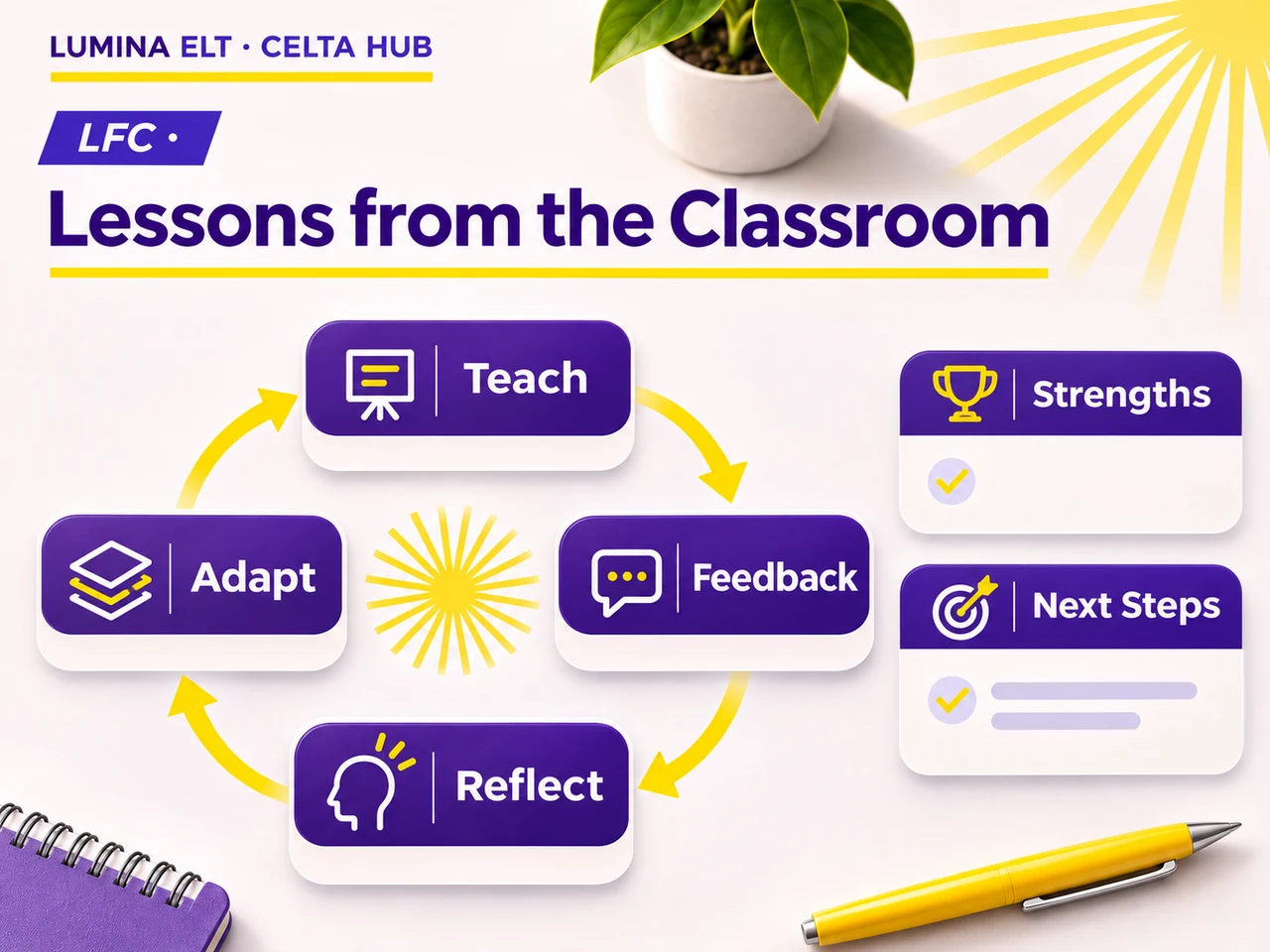
Start with relevant evidence from teaching practice, learner responses, tutor feedback, your self-evaluations and observations. Then consider what the evidence suggests about learning and why a technique helped or hindered it. Be selective: identify patterns and significant priorities rather than summarising every lesson.
- Evidence
- What happened in teaching or observation?
- Interpretation
- What does it suggest about learning?
- Action
- What will you try or investigate?
- Review
- How will you know if it helps?
A colleague uses an effective technique. Should you reproduce it exactly in your next lesson?
Consider what made it useful, the learners and aim, and how it might need adapting to your own context. Observation informs decisions; it doesn't replace them.
Strengths and development needs
Make each point specific and balanced. A strength is more convincing when you can explain its contribution to learning. A development need is more useful when it identifies a behaviour you can work on. You may find recurring priorities in monitoring, teacher talking time or task feedback. Do not select an area simply because it is common in CELTA feedback; choose what matters in your teaching.
Beyond the course: make your action plan realistic
Consider what you need to learn, how you will investigate it, where you will practise and what evidence you will review. Reading can build knowledge, but it is not the whole plan. Peer observation, a focused development discussion, recording your own teaching where permitted, and revisiting learner responses may all help. Use any format or number of development points specified by your centre.
Reading for professional development
- Professional Development for Language Teachers — Jack C. Richards and Thomas S. C. Farrell: practical development routes.
- Reflective Teaching in Second Language Classrooms — Jack C. Richards and Charles Lockhart: reflection and classroom inquiry.
- The Developing Teacher — Duncan Foord: development activities.
- Learning Teaching — Jim Scrivener: areas of classroom practice you may want to investigate.
Follow your centre's requirements for background reading, referencing and evidence. Where you draw on a professional source, acknowledge it; your reflection must still represent your own teaching and observation.
Before you submit
- Are my strengths and priorities based on specific evidence?
- Have I reflected on my own teaching and relevant observations?
- Do my development plans identify realistic actions beyond CELTA?
- Have I explained how I can review progress?
- Is the work genuinely my own reflection, written clearly?
Check your work against each criterion, not just the title of the task. For referencing, appendices and word-count advice, see our CELTA academic writing guide. Allow time to proofread and meet your deadline.
Resubmission is another chance to reflect
If your tutor asks you to revisit a point, use that feedback as part of the reflective process. Perhaps the evidence is too general, or the action plan isn't specific enough. Focus on the identified criteria, not on writing the perfect story of your course. You are developing as a teacher, and development continues after CELTA.
Explore the CELTA Hub
Continue with the other guides in our CELTA assignments series:
- Assignment 1: Focus on the Learner
- Assignment 2: Language Related Tasks
- Assignment 3: Language Skills Related Tasks
- Academic writing, APA referencing and submission tips
Check your understanding
6 short questions. No account needed, no score, and nothing you choose or write is saved or sent anywhere.
Show the answer (no automatic checking)
Answer: B. Reflection should start with authentic experience.
By Lumina Trainers
Show the answer (no automatic checking)
Answer: C. Reflection explains what evidence means and what to do next.
By Lumina Trainers
Show the answer (no automatic checking)
Answer: A. Specific action and review support development.
By Lumina Trainers
Show the answer (no automatic checking)
Answer: B. Observation can inform context-sensitive decisions.
By Lumina Trainers
Show the answer (no automatic checking)
Answer: 1–B, 2–C, 3–A. Effective reflection links these steps.
By Lumina Trainers
6 Choose a recurring teaching priority from your own feedback. What would count as evidence of progress?
Show a suggested answer
Use authentic feedback and identify a realistic indicator; the response should be personal to your experience.
Suggested answer by Lumina Trainers
Ahmed Bin NasserCELTA Tutor & Teacher Trainer | Lumina